
Steel Shed vs Plastic Shed: Which is the Better Choice for Your Storage Needs?
The obvious choice for a budget-friendly shed might actually cost you more in the long run. When you're weighing up a steel shed vs plastic shed, the upfront price tag rarely tells the whole story, and choosing the wrong material can mean replacing your storage solution far sooner than you planned.
You're not alone in feeling uncertain. Most buyers want the same things: a shed that holds up through harsh weather, doesn't demand constant upkeep, and keeps their belongings genuinely secure. Those are completely reasonable expectations, and the material you choose makes all the difference in whether they're met.
This article cuts through the noise and gives you a clear, honest comparison of both options. We'll walk you through durability, weather resistance, security, maintenance, and long-term value so you can make a confident, well-informed decision. Whether you're storing garden tools, outdoor equipment, or valuable gear, understanding what each material actually delivers will help you invest in the right solution from the start.
Key Takeaways
- When comparing a steel shed vs plastic shed, upfront cost is rarely the most important factor - durability, weather resistance, and long-term value tell a far more complete story.
- Steel and plastic sheds differ significantly in how they handle harsh conditions like UV exposure, heavy rain, and snow, and understanding these differences could save you from an early replacement.
- Maintenance requirements vary considerably between the two materials, and knowing what each demands over time will help you choose a shed that fits your lifestyle, not just your budget.
- Security is not equal across shed types - the material you choose directly affects how well your belongings are protected against forced entry and environmental damage.
- Real user experiences reveal consistent patterns about which shed type delivers on its promises, helping you make a confident, informed decision before you buy.
Understanding Shed Materials: Steel vs. Plastic
Not all sheds are built the same, and the material they're made from shapes almost every aspect of ownership: how long they last, how much work they require, and how well they protect what's stored inside. Before diving into a detailed steel shed vs plastic shed comparison, it helps to understand exactly what each material brings to the table.
What is a Steel Shed?
A steel shed is a prefabricated outdoor storage structure built from galvanised or coated steel panels, typically engineered for structural integrity under real-world conditions. The better-built options aren't just assembled from thin sheet metal; they're designed with interlocking panel systems, reinforced frames, and protective coatings that give them a measurably longer service life than most buyers expect.
Yodoko's steel sheds are a strong example of what this category can deliver at its best. Engineered in Japan and built to be rust-proof, fire-proof, and hurricane-rated, they represent a fundamentally different standard than the entry-level steel products you might find at a hardware chain. Critically, Yodoko backs this with a 20-year structural warranty, which is a meaningful commitment that reflects genuine confidence in the product's longevity. That kind of warranty isn't offered lightly, and for buyers thinking about long-term value, it matters.
Key characteristics of quality steel sheds include:
- High load-bearing capacity for shelving and heavy equipment
- Fire resistance, unlike timber or plastic alternatives
- Structural rigidity that holds up against wind and impact
- Long-term corrosion resistance when properly coated or galvanised
What is a Plastic Shed?
Plastic sheds are typically constructed from high-density polyethylene (HDPE) or resin-based materials, moulded into interlocking panels. They're lightweight, relatively easy to assemble, and marketed heavily on the basis of being low-maintenance. That last claim deserves some scrutiny.
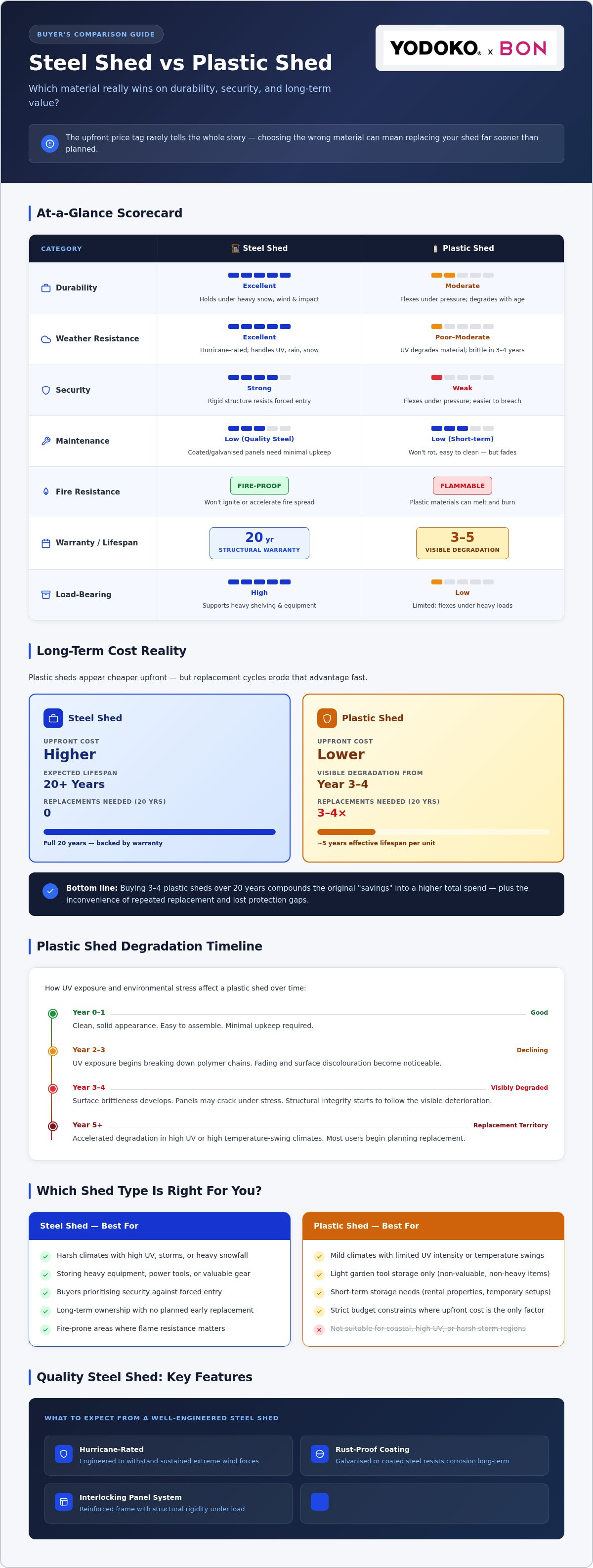
In the short term, plastic sheds do require less upkeep than untreated timber. They won't rot, and surface cleaning is straightforward. But plastic has a real weakness: UV degradation. Prolonged sun exposure causes the material to become brittle and discoloured over time, and this process accelerates in climates with intense sun or significant temperature swings. What starts as a clean, solid-looking structure can look worn and faded within a few years.
Plastic sheds also tend to flex under pressure, which limits their usefulness for storing heavier items and makes them less resistant to forced entry. For light garden tool storage in a mild climate, they can be adequate. For anything more demanding, the material's structural limitations become a genuine problem.
When you're evaluating a steel shed vs plastic shed side by side, this foundational difference in material quality sets the stage for every other comparison that follows.
Durability and Long-Term Performance
Durability isn't a single metric. It's the sum of how a material performs under rain, heat, cold, impact, and time, and the gap between steel and plastic becomes most visible when you stress-test both against real conditions.
Weather Resistance
Steel's structural advantage shows most clearly in extreme weather. A quality steel shed holds its shape under heavy snow loads, resists wind uplift in storms, and doesn't warp when temperatures swing dramatically between seasons. Yodoko's steel sheds are hurricane-rated, which means they've been engineered to withstand the kind of sustained wind forces that would compromise lesser structures entirely. That's not a marketing claim; it reflects deliberate design choices around panel thickness, frame reinforcement, and fastening systems.
Plastic sheds tell a different story under the same conditions. HDPE and resin materials are inherently sensitive to UV radiation. Over time, prolonged sun exposure breaks down the polymer chains within the material, causing visible fading, surface brittleness, and, eventually, cracking. In regions with intense summers or significant seasonal temperature variation, this process accelerates noticeably. What looks presentable in year one can appear visibly degraded by year three or four, and structural integrity often follows.
Consider two practical scenarios. In a coastal Australian climate with high UV intensity and occasional storm events, a plastic shed faces a dual threat: UV degradation weakens the panels while wind pressure tests the structural connections. A steel shed in the same environment, properly coated and anchored, handles both challenges without compromise. In a cold-climate setting with heavy snowfall, the load-bearing difference becomes equally significant. Plastic panels can bow or crack under sustained weight; steel panels don't.
Impact Resistance
Steel simply absorbs impact better. Whether it's a falling branch, a rogue piece of sports equipment, or accidental contact from a vehicle or lawnmower, steel dents before it breaks. Plastic cracks. That distinction matters because a dent is cosmetic; a crack compromises weatherproofing and can spread over time.
Placement also plays a role here. A shed positioned near a tree line, under overhanging branches, or in a high-traffic area of a yard is exposed to incidental impacts regularly. In those environments, choosing plastic introduces a genuine maintenance risk that compounds over years of ownership.
When you're comparing a steel shed vs plastic shed purely on durability, the evidence consistently points in one direction. Steel holds up. Plastic manages, until it doesn't. For anyone thinking in terms of a decade or more of reliable use, that distinction is the foundation of a sound long-term investment. Explore Yodoko's steel shed range to see how Japanese engineering translates into measurable, lasting performance.
Maintenance Needs: Steel vs Plastic
Durability determines how long a shed lasts; maintenance determines how much effort that lifespan costs you. These aren't the same thing, and conflating them leads buyers to underestimate what they're actually signing up for. In the steel shed vs plastic shed debate, both materials require some level of ongoing care, but the nature of that care differs considerably.
Maintenance for Steel Sheds
Quality steel sheds do require periodic attention, but the work is straightforward and infrequent when the shed is properly engineered from the start. Yodoko's steel sheds are built with rust-proof coatings as a core design feature, not an afterthought, which significantly reduces the maintenance burden compared to standard galvanised steel products.
Practical maintenance tasks for a steel shed include:
- Annual inspection: Check panel joints, fasteners, and the base seal for any signs of wear or minor corrosion, particularly after severe weather events.
- Surface cleaning: A rinse with a garden hose and mild detergent removes dirt, mould spores, and debris that can accumulate in panel seams over time.
- Prompt damage response: If a panel is dented or the protective coating is scratched, address it quickly. A small touch-up prevents a minor cosmetic issue from becoming a rust entry point.
- Ventilation checks: Ensure vents remain unobstructed to prevent condensation buildup inside, which can affect both the shed structure and stored contents.
The key advantage here is predictability. Maintenance tasks are minor, clearly defined, and easy to complete without specialist help. With a 20-year structural warranty backing the product, Yodoko's sheds are built to require minimal intervention across their service life.
Maintenance for Plastic Sheds
Plastic sheds are often marketed as virtually maintenance-free. That's accurate in one narrow sense: they don't rust, and surface cleaning is simple. A wipe-down with soapy water handles most grime. But the real maintenance challenge with plastic isn't cleaning; it's managing UV degradation.
Once the material begins to fade and become brittle, there's no practical way to reverse it. Applying UV-protectant sprays can slow the process, but they need reapplication several times a year to be effective, and they don't restore structural integrity once brittleness sets in. In climates with intense sun or wide temperature swings, owners often find themselves managing a losing battle by the middle years of ownership.
Avoiding dark colour options can help reduce heat absorption, and keeping the shed shaded where possible extends its lifespan. But these are workarounds, not solutions. When comparing a steel shed vs plastic shed on honest maintenance terms, steel demands more specific care but delivers more predictable, long-term results. Plastic asks less of you early on, then asks more when the material starts to fail.
Cost Considerations: Is Steel Worth the Investment?
Price is usually the first thing buyers look at, and it's rarely the most useful metric. The real question isn't which shed costs less to buy; it's which one costs less to own over five, ten, or twenty years. That shift in perspective changes the steel shed vs plastic shed comparison considerably.
Initial Purchase Price
Plastic sheds typically sit at a lower entry price point, which makes them attractive to buyers working within a tight budget. Steel sheds, particularly engineered options like Yodoko's LMDS and ESF models, carry a higher upfront cost that reflects the materials, manufacturing standards, and structural testing behind them. That gap is real, and it's worth acknowledging honestly.
What that price difference buys you matters, though. With a quality steel shed, you're paying for:
- Thicker, more robust panel construction that holds its integrity across seasons
- Rust-proof and fire-resistant engineering built into the product from the start
- A 20-year structural warranty that reflects genuine confidence in long-term performance
- Professional assembly options that ensure the structure is installed correctly
Accessories also factor into the real cost of either option. Shelving, anchor kits, and flooring solutions are available across both categories, but steel sheds can support heavier shelving loads without reinforcement, which can reduce what you need to spend on internal fitout.
Long-Term Cost of Ownership
This is where the investment case for steel becomes clearest. A plastic shed purchased at a lower price may need replacing within seven to ten years, depending on climate conditions and UV exposure. A quality steel shed, maintained with basic annual checks, is built to last well beyond that. Over a twenty-year period, the total cost of ownership tells a very different story than the initial price tag suggests.
Maintenance costs also accumulate differently. As covered earlier in this article, plastic sheds require ongoing UV-protectant treatments to slow degradation, and those costs add up. Steel sheds need periodic inspections and occasional touch-ups, but the labour and material costs involved are minimal compared to managing a shed that's actively deteriorating.
The warranty dimension deserves specific attention. Yodoko's 20-year structural warranty isn't a standard offering in this product category. It represents a meaningful reduction in financial risk for the buyer, covering structural performance across the period when most competing sheds would already have been replaced once or twice over.
When you're doing an honest comparison of a steel shed vs plastic shed on total cost, the numbers consistently favour steel for anyone planning to use their shed for more than a few years. Browse Yodoko's steel shed range to find the right model for your storage needs and budget.
User Experiences: Testimonials and Recommendations
Specs and technical comparisons only tell part of the story. What people actually experience after years of ownership fills in the gaps that product pages leave out. Across the steel shed vs plastic shed debate, real user feedback reveals consistent patterns that are worth paying close attention to before you commit.
Customer Testimonials on Steel Sheds
Yodoko customers consistently highlight two things above everything else: how well the shed holds up over time, and how straightforward the buying and assembly process turns out to be. One homeowner in Queensland described their Yodoko steel shed as "the last shed I'll ever need to buy," noting that after several years in a high-UV coastal environment, the structure looked and functioned exactly as it did on day one. That kind of feedback isn't unusual. It reflects what happens when engineering quality meets real-world conditions.
Common themes from steel shed owners include:
- Confidence after severe weather: Multiple customers report inspecting their steel sheds after storms and finding zero structural compromise, even when neighbouring properties sustained damage.
- Positive assembly experiences: Those who opted for Yodoko's professional assembly service consistently mention it as money well spent, particularly for larger shed configurations.
- Satisfaction with support: Buyers frequently note that questions were handled promptly and clearly, which matters when you're making a significant purchase decision.
- Long-term peace of mind: The 20-year structural warranty comes up repeatedly as a factor that made the decision feel genuinely low-risk.
Customer Testimonials on Plastic Sheds
Plastic shed owners tend to start satisfied and grow less so over time. Early reviews often praise the ease of assembly and the clean initial appearance. The concerns emerge later, typically around years two to four, when UV fading becomes visible and panel rigidity starts to decline. Several owners describe a frustrating cycle of applying UV-protectant sprays seasonally, only to watch the material continue degrading regardless.
A recurring theme is regret over storage limitations. Buyers who initially thought a plastic shed would be adequate for garden tools often find themselves unable to add heavier shelving or store larger equipment without the structure flexing under the load. For light, occasional use in a shaded position, plastic sheds can satisfy. For anything more demanding, the feedback patterns are telling.
Your specific situation matters here. If you're storing lightweight seasonal items and your budget is genuinely constrained, a plastic shed might serve you adequately in the short term. But if you want reliable, secure storage that performs consistently for a decade or more, the real-world evidence points clearly toward steel. Explore Yodoko's steel shed range and find the right fit for your needs.
Make the Right Call for Your Storage Needs
The steel shed vs plastic shed decision comes down to one honest question: how long do you actually need your shed to perform? If the answer is a decade or more, the evidence throughout this article points clearly in one direction. Steel holds up under harsh weather, demands minimal maintenance, and protects your belongings far more reliably than plastic manages over time.
Plastic sheds can work for light, short-term storage. But if you're investing in something that needs to last, the structural limitations and UV degradation issues are hard to overlook once you understand them.
Yodoko's steel sheds bring something genuinely different to this category: Japanese-engineered construction that's rust-proof, fire-proof, and hurricane-rated, backed by a 20-year structural warranty that removes the guesswork from your decision. That's not a small thing. It's the kind of confidence that comes from building a product designed to outlast the alternatives.
You deserve a shed that earns its place on your property for years to come. Explore Yodoko's premium steel sheds today! and find the right fit for your space.
Frequently Asked Questions
What are the main differences between steel and plastic sheds?
Steel sheds are built from galvanised or coated steel panels engineered for structural strength, fire resistance, and long-term durability. Plastic sheds are typically made from HDPE or resin, moulded into lightweight interlocking panels. The core difference comes down to structural integrity: steel holds its shape and strength across decades, while plastic is prone to UV degradation, flexing under load, and cracking over time.
Security is another meaningful distinction. Steel panels resist forced entry far more effectively than plastic, which can be compromised with relatively little effort. For anyone storing tools, equipment, or anything of value, that difference matters.
How do I choose the right shed for my needs?
Start with two questions: what are you storing, and how long do you need it to last? If you're keeping lightweight garden tools in a shaded spot and expect to replace the shed within a few years, a plastic option may be adequate. If you're storing heavier equipment, valuable gear, or anything that needs reliable protection from weather and forced entry, a steel shed is the more practical choice.
Your local climate should also factor into the decision. High UV exposure, coastal conditions, heavy snowfall, or frequent storms all place demands on shed materials that plastic handles less reliably than steel over time.
Are steel sheds more expensive than plastic sheds?
Steel sheds typically carry a higher upfront cost than plastic alternatives, and that's worth acknowledging honestly. What matters more, though, is total cost of ownership across the life of the shed. A plastic shed that needs replacing within seven to ten years, combined with ongoing UV-protectant treatments, can easily exceed the investment in a quality steel shed that's built to last significantly longer.
Yodoko's steel sheds are backed by a 20-year structural warranty, which meaningfully reduces long-term financial risk. That kind of coverage isn't common in this product category, and it shifts the cost comparison considerably in favour of steel for buyers thinking beyond the initial purchase.
What maintenance is required for steel sheds?
Quality steel sheds don't demand much, but they do reward consistent basic care. An annual inspection of panel joints, fasteners, and the base seal keeps small issues from becoming larger ones. A rinse with a garden hose and mild detergent removes accumulated dirt and mould spores from panel seams. If a coating is scratched or a panel is dented, addressing it promptly prevents moisture from finding an entry point.
Yodoko's steel sheds are built with rust-proof coatings as a core engineering feature, which significantly reduces the maintenance burden compared to standard galvanised steel products. The tasks involved are simple, infrequent, and don't require specialist help.
Do plastic sheds last as long as steel sheds?
In most real-world conditions, no. Plastic sheds are particularly vulnerable to UV degradation, which causes fading, brittleness, and eventually cracking. This process accelerates in climates with intense sun or wide temperature swings, and there's no practical way to reverse it once it sets in. UV-protectant sprays can slow the decline but require repeated seasonal application and don't restore structural integrity.
A well-maintained steel shed vs plastic shed comparison over a ten-to-twenty-year period consistently shows steel delivering far more reliable performance. Plastic sheds can satisfy light, short-term storage needs, but they're not built to the same longevity standard as quality engineered steel.
How do weather conditions affect shed performance?
Weather is where the gap between steel and plastic becomes most visible. Steel sheds hold their shape under heavy snow loads, resist wind uplift during storms, and don't warp through seasonal temperature changes. Yodoko's steel sheds are hurricane-rated, reflecting deliberate engineering choices around panel thickness, frame reinforcement, and fastening systems that allow them to handle sustained wind forces.
Plastic sheds face a dual challenge in harsh climates: UV radiation weakens the panels structurally while wind and snow loads test connections that aren't designed for sustained pressure. Coastal environments, regions with intense summers, and areas with significant snowfall all expose plastic's material limitations in ways that become genuinely problematic over time.
Can I customise my steel shed?
Yodoko offers steel shed accessories that allow you to configure your storage space to suit your specific needs. Because steel panels support significantly higher load capacities than plastic, you can add heavier shelving and store larger equipment without worrying about the structure flexing or the shelving system failing under weight. That load-bearing advantage makes steel sheds far more adaptable as your storage needs evolve.
For buyers who want a professional result from the start, Yodoko's assembly service ensures the shed is installed correctly, which is particularly valuable for larger configurations where precise installation directly affects structural performance and longevity.