
Steel Sheds: The Complete Buyer's Guide for 2026
Not all steel sheds are created equal, and choosing the wrong one can cost you far more than just money. Whether you're storing garden equipment, protecting valuable tools, or creating a dedicated workspace, the shed you choose needs to stand up to the elements year after year without becoming a maintenance headache.
If you've found yourself overwhelmed by conflicting advice, confusing size charts, and materials that sound similar but perform very differently, you're not alone. Picking the right steel shed is genuinely one of those decisions that rewards a little research upfront and punishes a rushed choice for years afterward.
This guide cuts through the noise. You'll learn exactly what makes a quality steel shed worth the investment, how to match size and style to your specific needs, and what to look for before you commit to a purchase. From understanding the engineering behind rust-proof and fire-proof construction to navigating installation options, everything you need to make a confident, well-informed decision is right here.
Key Takeaways
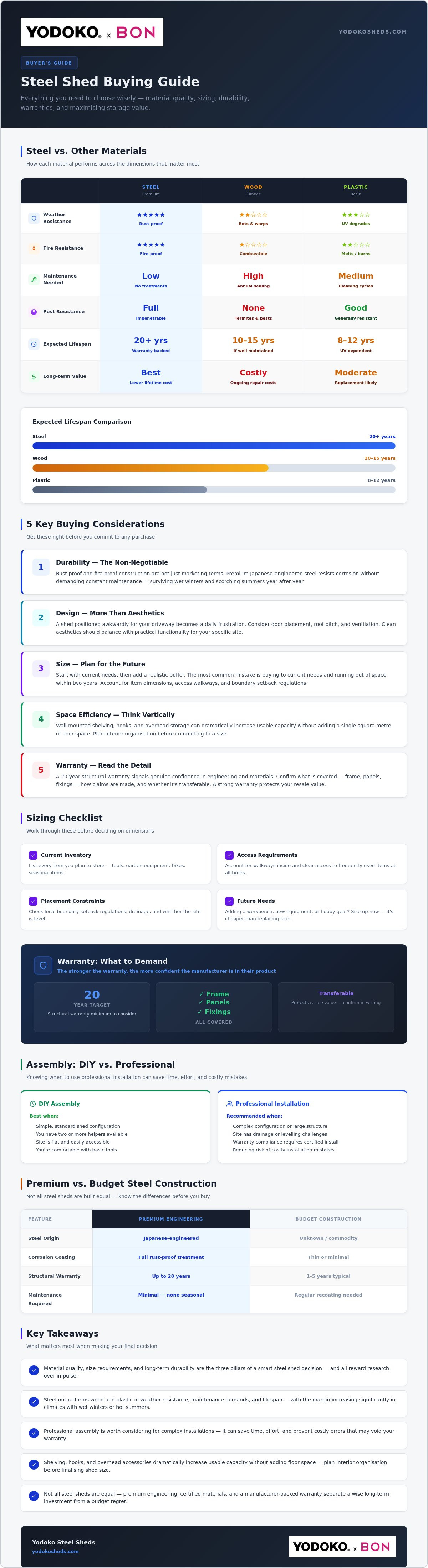
- Choosing the right steel shed comes down to understanding key features like material quality, size requirements, and long-term durability - all of which this guide breaks down clearly.
- Steel outperforms wood and plastic in critical areas including weather resistance, maintenance demands, and lifespan, but the margin varies depending on your climate and how you use the shed.
- Professional assembly is worth considering for complex installations, and knowing when to use it can save you time, effort, and costly mistakes.
- The right accessories - from shelving to storage hooks - can dramatically increase how much you get out of your shed without adding floor space.
- Not every steel shed is built to the same standard; understanding what separates premium engineering from budget construction will help you invest wisely and avoid regret.
What to Consider When Buying a Steel Shed
Buying a steel shed is a long-term investment, and the decisions you make upfront will shape how well it serves you for years to come. Get the fundamentals right, and you'll end up with a structure that earns its place in your garden. Get them wrong, and you'll be dealing with rust patches, cramped storage, or a warranty that doesn't cover what you thought it would.
Key Features of Steel Sheds
Not every steel shed is built with the same materials or to the same engineering standards. The features that genuinely matter are durability, design, and how efficiently the space works for you.
Durability is the non-negotiable starting point. Rust-proof and fire-proof construction aren't just marketing terms; they're the difference between a shed that holds up through wet winters and scorching summers versus one that deteriorates within a few seasons. Premium Japanese-engineered steel, like that used in Yodoko sheds, is specifically designed to resist corrosion without demanding constant maintenance.
Design matters more than people expect. A shed that looks out of place in your garden or has doors positioned awkwardly for your driveway becomes a daily frustration. Look for options that balance clean aesthetics with practical functionality, including door placement, roof pitch, and ventilation.
Space efficiency is often overlooked at the buying stage. Wall-mounted shelving, hooks, and overhead storage can dramatically increase usable capacity without adding a single square metre of floor space. Think about how the interior will actually be organised before you commit to a size.
Determining the Right Size for Your Shed
Start with what you need to store right now, then add a realistic buffer for the future. A common mistake is buying to current needs and running out of space within two years. Consider not just the volume of items but their dimensions; a ride-on mower, for example, needs clearance for the door to open fully with the machine inside.
- Current inventory: List every item you plan to store, including tools, garden equipment, bikes, and seasonal items.
- Access requirements: Account for walkways inside the shed and clear access to frequently used items.
- Placement constraints: Check local regulations on boundary setbacks and ensure the site allows for proper drainage and a level base.
- Future needs: If there's any chance you'll add a workbench, a lawnmower upgrade, or hobby equipment, size up now rather than later.
Understanding Warranties and Guarantees
A warranty tells you exactly how much confidence a manufacturer has in their own product. A 20-year structural warranty, like the one that backs Yodoko steel sheds, signals genuine confidence in the engineering and materials used. But read the detail carefully. Understand what's covered, whether that includes the frame, panels, and fixings, and what conditions might void the coverage.
A strong warranty also protects your resale value. A shed with documented, transferable warranty coverage is a more attractive asset than one with no paper trail. Before purchasing any steel shed, confirm in writing what the warranty covers, how claims are made, and whether it's backed by the manufacturer directly.
Steel Shed vs. Other Materials: Which One Wins?
The choice between steel, wood, and plastic isn't just about aesthetics or upfront price. It's a decision that plays out over years, sometimes decades, in maintenance hours, repair bills, and how well your shed actually holds up when the weather turns nasty. Each material has genuine trade-offs, and understanding them clearly makes the decision straightforward.
Durability and Maintenance
Wood sheds have a natural appeal, but that appeal comes at a cost. Timber is vulnerable to rot, warping, and pest damage, particularly in climates with high humidity or frequent rainfall. Without regular sealing, staining, or painting, a wooden shed can deteriorate noticeably within just a few years. Plastic (resin) sheds avoid the rot problem but introduce their own weaknesses: UV degradation causes brittleness over time, and they can crack or distort under significant temperature swings.
A quality steel shed sidesteps both of these issues. Rust-proof and fire-proof steel construction doesn't require seasonal treatments or repainting cycles. There's no timber to warp, no resin to crack, and no pest that can chew through the walls. In terms of raw life expectancy, premium steel sheds consistently outlast both alternatives, particularly in climates that swing between wet winters and dry summers.
Cost-Effectiveness Over Time
Wooden sheds often carry a lower sticker price, which makes them look attractive at the point of purchase. But the true cost includes ongoing maintenance: wood treatments, replacement panels, pest control, and eventually a full rebuild. Plastic sheds are similarly deceptive; they're cheap upfront but brittle over time, and replacement parts aren't always available once a product line is discontinued.
Steel sheds typically require little more than an occasional clean. When you factor in the absence of annual maintenance costs and the reduced likelihood of needing structural repairs, the long-term economics shift decisively in steel's favour. A shed backed by a 20-year structural warranty, as Yodoko steel sheds are, also provides a level of financial certainty that wood and plastic simply can't match.
Environmental Considerations
Steel has a meaningful sustainability advantage that often goes unmentioned. It's one of the most recycled materials on the planet, and at the end of its usable life, a steel shed can be fully recycled rather than sent to landfill. Wood sourcing, by contrast, varies widely in its environmental credentials depending on whether the timber is certified and responsibly managed. Plastic sheds present the most significant end-of-life problem; resin doesn't biodegrade, and recycling options for composite plastic structures are limited.
For buyers who care about long-term environmental impact alongside long-term performance, steel is the most defensible choice across the full product lifecycle.
If you're ready to see how premium steel construction translates into a practical, low-maintenance storage solution, explore the Yodoko steel shed range and find the right fit for your space.
Assembly Options for Your Steel Shed
Once you've chosen your steel shed, the next decision is how to get it standing. This is where many buyers make a costly assumption: that assembly is straightforward regardless of the shed's size or complexity. The reality is more nuanced, and choosing the right approach upfront saves you time, frustration, and potentially money.
Self-Assembly: Pros and Cons
Self-assembly is a legitimate option for confident DIYers, particularly with smaller shed models. The main advantage is cost savings; you're not paying for labour, and you can work at your own pace. There's also a practical benefit: assembling the shed yourself gives you a thorough understanding of how it's constructed, which can be useful if you ever need to modify or repair it later.
That said, the challenges are real. Steel shed panels are heavy and awkward to manoeuvre solo. Most assemblies require at least two people for safe handling. Before you start, you'll need:
- A level, prepared concrete or paved base
- A cordless drill and appropriate bits
- A rubber mallet
- A spirit level
- A tape measure and square
- A second person to assist with panel positioning
Underestimating the time involved is the most common pitfall. A shed that looks manageable on paper can take a full weekend when you account for base preparation, panel alignment, and fixing everything securely.
Professional Assembly Services: What to Know
For larger installations, complex site conditions, or simply when your time is better spent elsewhere, professional assembly is worth serious consideration. Yodoko offers an assembly service that takes the guesswork out of the process entirely. A professional team understands the specific engineering of the shed they're installing, which means panels are aligned correctly, fixings are torqued properly, and the structure is sound from day one.
This matters more than it might seem. An incorrectly assembled steel shed can develop issues over time: doors that don't close cleanly, panels that flex under wind load, or fixings that work loose. Professional installation eliminates these risks at the outset.
When evaluating assembly services, ask specifically whether the team has experience with the shed model you've purchased. Familiarity with the product makes a meaningful difference to the quality and speed of the installation.
The cost of professional assembly varies depending on shed size and site access, so it's worth getting a clear quote before you purchase. For most buyers, the combination of time saved and confidence in a correctly installed structure makes it a straightforward decision.
Maximizing Storage with Steel Shed Accessories
A steel shed is only as useful as the storage system inside it. The structure gives you the space; the right accessories determine how much of that space you actually use. Done well, a thoughtfully accessorised shed can hold twice what an empty shell of the same size manages. Done poorly, it becomes a cluttered room where nothing is easy to find.
Essential Accessories for Steel Sheds
Shelving units are the single highest-impact addition you can make. Vertical space is almost always underused in sheds, and wall-mounted shelving pulls storage off the floor entirely, freeing up room for larger equipment like mowers and bikes. Adjustable shelving is worth the investment; fixed shelves force you to work around them, while adjustable units adapt as your storage needs change over time.
Anchoring kits are a non-negotiable safety feature, not an optional extra. A steel shed that isn't properly secured to its base can shift under high winds, compromising the structure and potentially causing damage to whatever's stored inside. Anchoring ensures the shed performs exactly as it was engineered to, even in challenging weather conditions.
For day-to-day organisation, hooks and bins make a genuine difference. Consider:
- Tool hooks: Keep long-handled tools like rakes, spades, and brooms off the floor and visible at a glance
- Bike hooks: Wall or ceiling-mounted options that reclaim significant floor space
- Stackable bins: Ideal for seasonal items, hardware, or anything that doesn't need to be accessed regularly
- Pegboards: Flexible, reconfigurable panels that work well above a workbench
Customization Options
Beyond storage, there's real value in making your shed work harder as a space. LED lighting is one of the most practical upgrades available; a well-lit shed is safer to work in and makes finding tools far faster. If you're planning to use the shed as a workspace rather than pure storage, a power connection opens up options for power tools, battery chargers, and task lighting.
Security is worth taking seriously. A reinforced door lock or hasp adds meaningful deterrence without significant cost, and it's far easier to install before the shed is full of equipment than after. If your shed will house high-value tools or machinery, it's worth treating security as a baseline requirement rather than an afterthought.
Yodoko's range of shed accessories is designed specifically to complement their steel shed models, so you're not hunting for third-party parts that may or may not fit. Browse the full Yodoko accessories range to find everything you need to get the most from your shed from day one.
Why Choose Yodoko Steel Sheds?
At this point in your buying journey, you understand what makes a quality steel shed worth the investment. The question becomes simpler: which manufacturer actually delivers on those standards? Yodoko's answer is built into the product itself, not just the marketing around it.
The Yodoko Advantage
The foundation of every Yodoko shed is premium Japanese-engineered steel. Japanese steel manufacturing is recognised globally for its precision tolerances and material consistency, and that engineering heritage translates directly into how these sheds perform over time. Rust-proof, fire-proof, and hurricane-rated construction aren't features bolted on as selling points; they're the result of a manufacturing process designed from the ground up for long-term outdoor performance.
What genuinely separates Yodoko from the crowded shed market is the confidence behind the product. A 20-year structural warranty is a meaningful commitment. It tells you that the engineering team stands behind the materials and construction methods, and that you're protected across a timeframe most competitors won't touch. That kind of backing doesn't come from a manufacturer cutting corners on steel grade or panel thickness.
Yodoko offers two core steel shed models, the LMDS and the ESF, giving buyers a clear choice based on their size requirements and intended use rather than forcing a one-size-fits-all decision. Both are built to the same engineering standard, so you're not trading quality for a smaller footprint.
Customer Support and Services
Choosing the right shed is only part of the process. Yodoko supports customers from initial selection through to a fully assembled, ready-to-use structure. The professional assembly service removes the most common point of friction for buyers, particularly those dealing with larger models or challenging site conditions. Rather than spending a weekend wrestling with panels, you can have the job done correctly by people who know the product inside out.
For those who prefer to self-assemble, Yodoko provides the resources needed to do it properly. And if questions come up along the way, whether during selection, assembly, or ongoing use, the team is available to help. That kind of support matters, especially when you're making a purchase designed to last two decades.
Yodoko also offers a dedicated range of shed accessories, including shelving, anchoring kits, and organisational tools, all designed to complement their steel shed models directly. You're not left searching for third-party parts that may or may not fit.
If you're ready to invest in a steel shed built to perform for the long haul, explore the full Yodoko range and find the model that fits your space, your needs, and your budget.
Make the Right Choice and Get More From Your Outdoor Space
Choosing a steel shed is one of those decisions that pays dividends for years when you get it right. You now have the tools to do exactly that: a clear understanding of what separates quality construction from budget alternatives, how to size your shed for current and future needs, and how accessories can transform a basic structure into a genuinely useful space.
The core lesson is straightforward. Not all steel sheds are built to the same standard, and the gap between a premium product and a cheap alternative becomes very obvious after a few harsh winters. Rust-proof and fire-proof materials, Japanese-engineered quality, and a 20-year structural warranty aren't just features to tick off a list; they're the difference between a shed that holds up and one that lets you down.
You've done the research. Now it's time to find the right fit for your garden and your budget. Explore our premium Yodoko steel sheds today and invest in a structure built to last.
Frequently Asked Questions About Steel Sheds
What should I look for when buying a steel shed?
Prioritise material quality, warranty coverage, and practical design features. The steel grade determines how well the shed resists rust and weathering over time, so look for rust-proof construction backed by documented engineering standards. Door placement, roof pitch, and ventilation all affect daily usability more than most buyers expect.
Don't overlook the warranty terms. A strong structural warranty signals genuine manufacturer confidence in the product. Read what's covered carefully, including whether the frame, panels, and fixings are all included, and confirm how claims are made before you commit.
Are steel sheds fire-resistant?
Quality steel sheds are fire-proof by nature of the material itself. Unlike timber, steel doesn't ignite or feed a fire, which makes it a significantly safer option for storing flammable materials like fuel, fertilisers, or paint. Yodoko steel sheds are built with fire-proof construction as a core engineering feature, not an optional upgrade.
This fire resistance also has practical insurance implications. Storing hazardous materials in a fire-proof structure may be viewed more favourably by your home insurer, so it's worth checking your policy terms when deciding what you'll keep in the shed.
How do I know what size shed I need?
Start by listing everything you plan to store, then measure the largest items to understand the minimum floor space and door clearance you'll need. A ride-on mower, for example, requires enough room to enter and exit without awkward manoeuvring. Once you have that baseline, add space for a walkway and any workbench or shelving you plan to install.
The most reliable rule is to size up slightly beyond your current needs. Most people find their storage requirements grow within a couple of years, and a shed that feels spacious today can feel cramped quickly once tools, seasonal equipment, and hobby items accumulate.
Can I customise my steel shed?
Yodoko offers two steel shed models, the LMDS and the ESF, giving you a choice based on your size and usage requirements. While bespoke or custom-built shed design isn't part of the offering, both models support a range of accessories including shelving, hooks, and organisational tools that let you tailor the interior layout to your specific needs.
Practical upgrades like LED lighting, reinforced locks, and anchoring kits can also be added to improve functionality and security. These additions let you adapt the shed to your situation without needing a custom structure.
What accessories are available for steel sheds?
Yodoko offers a dedicated accessories range designed to work directly with their steel shed models. Options include wall-mounted shelving, anchoring kits, tool hooks, and storage bins. These are purpose-matched to the shed dimensions, so you're not adapting third-party parts that may not fit cleanly.
Anchoring kits are particularly important and shouldn't be treated as optional. Securing the shed to its base protects the structure during high winds and ensures it performs as engineered. Shelving and hooks are the next priority, since they dramatically increase usable capacity without requiring a larger shed footprint.
How do I maintain my steel shed?
A quality steel shed is genuinely low maintenance. Unlike timber, it doesn't need annual sealing, staining, or painting. An occasional clean with water to remove dirt, debris, and leaf build-up around the base and roof is typically all that's required to keep it in good condition year after year.
Check the door hinges and fixings periodically to ensure nothing has worked loose, and clear gutters or drainage channels if your shed design includes them. The absence of ongoing maintenance costs is one of steel's most practical advantages over wood alternatives, and it's worth factoring into your total cost of ownership when comparing options.
What is the warranty on Yodoko steel sheds?
Yodoko steel sheds are backed by a 20-year structural warranty. This covers the engineering and construction of the shed and reflects the confidence Yodoko has in the premium Japanese-engineered steel used throughout their range. It's one of the strongest warranty commitments available in the steel shed market.
Before purchasing, confirm the specific terms in writing, including which components are covered and how claims are submitted. A warranty of this length also has practical value beyond peace of mind; it supports the resale value of your property and provides documented assurance that the structure will perform over the long term.