

Cost of Shed Installation: The 2026 Professional Pricing Guide
Is the money you save on a budget assembly worth the 20-year warranty you might be accidentally voiding? When you invest in a high-performance steel structure, the true cost of shed installation isn't just about the labor hours billed by a local handyman. It's about ensuring that Japanese engineering remains hurricane-rated and fireproof for decades to come. You've likely spent hours researching the perfect storage solution, only to feel overwhelmed by confusing quotes and the fear of hidden site preparation fees. It's frustrating when you can't get a straight answer on what a professional, warrantied setup actually costs in 2026.
This guide provides the clarity you need by breaking down the total investment required for a professional assembly that protects your structural integrity. We'll explore the variables that dictate assembly fees, explain why specialized steel sheds like the LMDS or ESF require precision labor, and help you budget for a site that meets every safety rating. By the end, you'll have the confidence to choose an assembly service that turns a simple purchase into a permanent, high-value asset for your property.
Key Takeaways
- Discover how shed dimensions and advanced steel engineering influence 2026 labor rates differently than standard wood builds.
- Get a transparent breakdown of the cost of shed installation by analyzing the value of flat-fee pricing versus hourly handyman quotes.
- Learn why a precision-leveled foundation is the most important "hidden" cost for ensuring long-term structural integrity and performance.
- Understand the value of professional assembly in validating your 20-year structural warranty and meeting hurricane-rated standards.
- Evaluate the hidden expenses of DIY assembly, such as specialized tool requirements and the significant time commitment required for a proper build.
Key Factors Influencing Shed Installation Costs in 2026
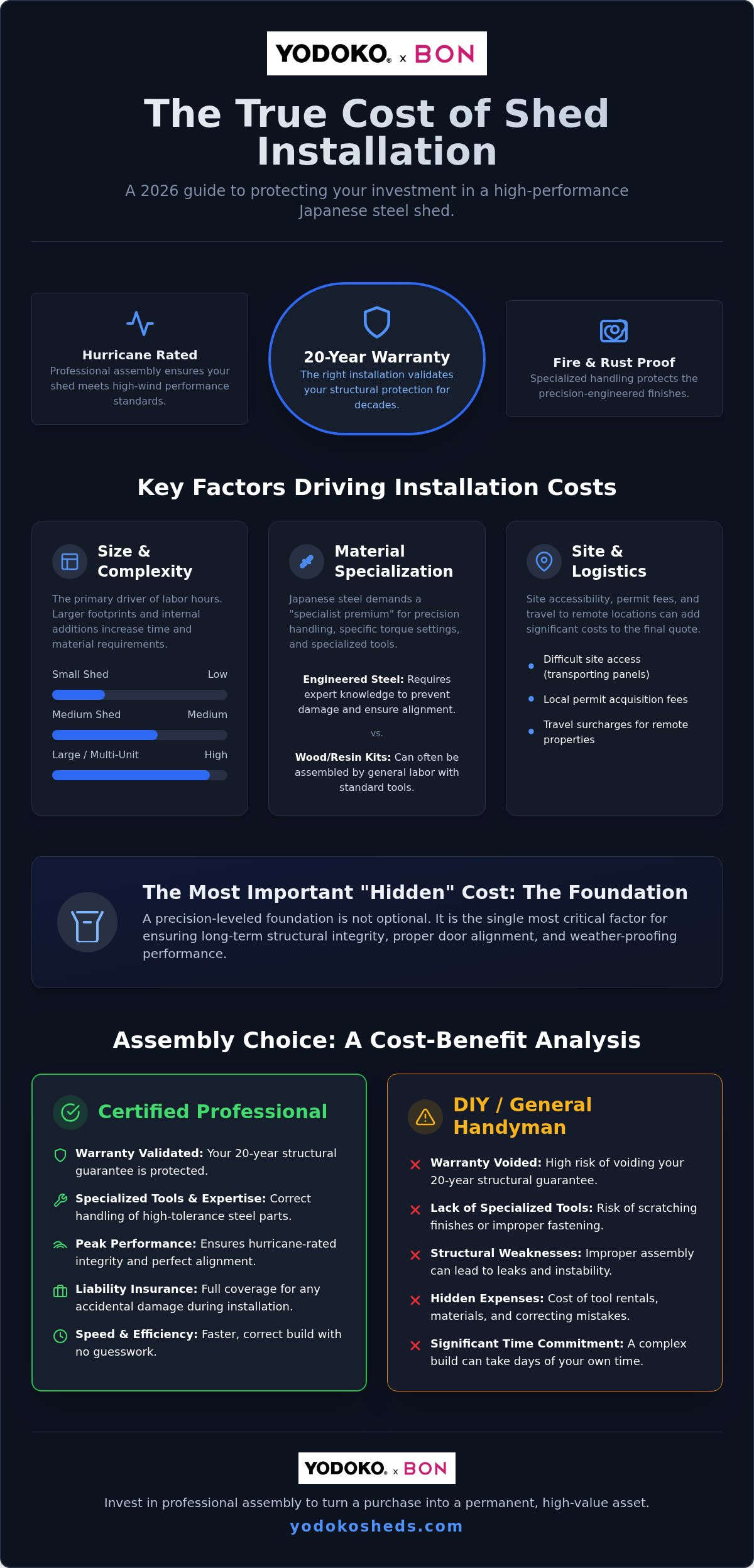
Calculating the total cost of shed installation involves more than just looking at a sticker price for labor. In 2026, professional installers evaluate several logistical and structural variables before providing a final quote. While a basic resin kit might take a few hours for a general handyman, high-performance Japanese steel structures require a more technical approach. You aren't just paying for someone to turn a screwdriver; you're paying for the specialized knowledge required to maintain structural integrity.
Logistics play a major role in your final estimate. If your chosen site is far from the delivery drop-off point, installers spend significantly more time transporting heavy steel panels across your property. This manual transport adds to the labor hours. You also need to consider administrative fees. Permit acquisition costs vary by local municipality, but securing these documents ensures your structure remains compliant with local zoning laws. Skipping this step is a common mistake that can lead to expensive fines or forced removal later.
Size and Model Complexity
The footprint of your shed is the primary driver of labor hours. Larger models, such as the Yodoko Sheds LMDS series, require a higher number of anchor points to ensure stability against environmental stressors. As the square footage increases, so does the volume of hardware and the time needed for precise leveling. It's not just about the exterior walls. Internal complexity matters too. Installing heavy-duty shelving or specialized accessories requires additional time to ensure every component is perfectly aligned and secured to the frame. A larger utility unit with multiple internal configurations will naturally command a higher assembly fee than a compact storage locker.
Material-Specific Labor Requirements
Not all sheds are created equal, and the material dictates the toolset and expertise required. Precision-engineered steel sheds, like the Yodoko Sheds ESF model, demand a level of accuracy that wood or plastic simply don't require. Because these units feature fire-proof and rust-proof finishes, the panels must be handled with extreme care during the assembly process to prevent scratches or damage to the protective coating. Professional installers use specialized equipment to secure the shed to its foundation, ensuring it meets high-wind and hurricane-rated performance standards. This precision alignment is what validates your 20-year structural warranty. General labor often lacks the specific experience needed for these high-tolerance Japanese designs, which can lead to structural weaknesses or voided protections. Investing in specialized assembly ensures the engineering performs exactly as intended.
Labor Rates and Professional Assembly Breakdown
Understanding the labor market in 2026 is essential for setting a realistic budget. The cost of shed installation is no longer a one-size-fits-all figure. Professional installers typically offer two pricing structures: flat-fee and hourly. Flat fees provide price certainty for standard models, while hourly rates are more common for complex builds or sites with difficult access. You should also account for logistical surcharges if your property is in a remote location, as travel time and fuel costs are often billed separately.
Specialized steel structures command what industry pros call a specialist premium. Unlike wood sheds that use standard framing, Japanese-engineered steel requires specific torque settings and alignment techniques. Paying for this expertise ensures your investment doesn't suffer from leaks or structural weaknesses caused by improper handling. It's a small price to pay for the peace of mind that comes with a perfectly executed build. Skilled installers understand how to handle the unique finishes of these units without compromising their rust-proof properties.
Certified Installers vs. General Handymen
Choosing between a general handyman and a certified expert is a decision about risk. A generalist might offer a lower initial quote, but they often lack the specialized tools required for high-grade steel. Most importantly, using uncertified labor can void your 20-year structural warranty. Brand-specific experts work with higher speed and efficiency because they know the hardware inside and out. They also provide essential liability insurance, ensuring that any accidental damage during the installation is fully covered. For a seamless experience, consider adding a professional assembly service to your order.
Additional Labor for Customizations
Customizing your storage space also impacts the final labor tally. Installing advanced shelving systems or internal organizers requires extra time for layout and mounting. If you live in a high-wind zone, installers must perform technical anchoring to meet hurricane-rated standards. This process involves specialized hardware and precise drilling into your concrete or gravel foundation. Integration of security features, such as multi-point locking mechanisms, also adds to the complexity. These steps are vital for maximizing the utility and safety of your shed, ensuring it stands up to both intruders and the elements.
DIY Assembly vs. Professional Service: A Cost-Benefit Analysis
The upfront cost of shed installation often tempts homeowners to pick up a wrench and tackle the project themselves. However, a true cost-benefit analysis reveals that the DIY route involves significant hidden expenses that can outweigh the initial labor savings. When you assemble a precision-engineered steel structure like the YODOKO ESF, you aren't just putting parts together. You're calibrating a high-performance system designed for longevity. Mistakes made during a self-build lead to leaks, rattling panels, or structural failure during high-wind events. Choosing professional assembly is a financial strategy to protect your long-term investment and avoid the recurring repair costs associated with improper initial setup.
Structural peace of mind is the ultimate return on investment. High-value assets like power tools, lawn tractors, or seasonal equipment deserve a secure environment. If a DIY build fails to meet hurricane-rated standards because of a missed anchor point, the cost to replace your belongings will far exceed the price of a professional install. Professionals ensure the structure performs as the Japanese engineers intended, providing a level of reliability that a weekend project simply can't guarantee.
Tool and Equipment Requirements
You need more than a standard screwdriver to build a steel shed correctly. Professional assembly requires a specific arsenal of tools, including impact drivers, calibrated torque wrenches for precise bolt tension, and high-accuracy levels. If you don't already own these, the cost of purchasing or renting specialized equipment quickly eats into your budget. You also need proper safety gear and lifting equipment to handle heavy steel panels without causing injury or scratching the rust-proof finish. Professional crews arrive with everything needed to do the job right the first time, removing the logistical burden of tool sourcing from your shoulders.
Opportunity Cost and Time Management
Your time has a specific dollar value. A DIY build for a large LMDS model is rarely a single-afternoon task. For most homeowners, it turns into a multi-day commitment that consumes entire weekends. Professional crews can often complete a full installation in about four hours, depending on the site. This "white-glove" experience covers everything from the delivery drop-off to the final anchor. Experts also have the experience to handle unexpected site issues on the fly, such as minor grade adjustments or hardware tweaks, without stalling the project. When you factor in the value of your time and the certainty of a perfect build, professional service becomes the clear choice for savvy property owners.
Site Preparation and Foundation: The 'Hidden' Installation Costs
The total cost of shed installation often includes expenses you won't see on a product page. Site preparation is the most significant of these "hidden" costs. For Japanese steel engineering, a level foundation is non-negotiable. If your base is uneven, the precision-aligned panels of an LMDS or ESF shed won't fit perfectly, which can compromise the fire-proof and rust-proof integrity of the unit. You're not just buying a floor; you're building the structural starting point for a 20-year investment.
Backyard conditions vary wildly. If your chosen spot requires land clearing or significant grading to remove a slope, your labor costs will rise. These prep steps are essential to prevent water pooling and shifting over time. Additionally, shed placement regulations often dictate setbacks from property lines or existing structures. These rules can force you to choose a site that needs more extensive preparation, directly impacting your budget. It's better to invest in a proper site now than to face structural issues later.
Foundation Options and Their Price Points
Choosing the right base depends on your local climate and the intended use of the shed. Concrete slabs are the gold standard for stability and are often required for anchoring a shed to a concrete slab in high-wind areas. This permanent masonry solution provides the best support for heavy utility storage. Gravel bases offer a budget-friendly alternative that provides excellent drainage, which is vital for preventing rust in humid environments. While timber frames are sometimes used, they lack the multi-decade longevity of concrete or stone foundations. Each option has a different impact on the overall cost of shed installation, so you should choose based on your long-term performance needs.
Permits and Building Codes
Don't overlook the administrative side of site prep. Understanding shed building codes and permit requirements is vital before you break ground. Average permit fees change depending on your municipality, but the cost of non-compliance is always higher. Fines or the requirement to move a completed structure can double your total investment. Professional installers often assist with code-compliant placement, ensuring your shed meets local zoning and safety standards from day one. This expert guidance removes the guesswork and protects your property value. To ensure your site is ready for a precision build, you can book a professional assembly consultation to review your foundation plan.
Maximizing ROI with Yodoko Professional Assembly
Choosing professional assembly is the most effective way to protect your long-term investment. While the upfront cost of shed installation is a factor in your budget, the real value lies in the decades of performance that follow. A YODOKO LMDS or ESF steel shed is a high-performance asset, and an expert build ensures that every component functions exactly as the Japanese engineers intended. Professional assembly doesn't just save you a weekend; it acts as a structural insurance policy that validates your 20-year structural warranty. If a shed isn't leveled and anchored to exact specifications, you risk losing the very protections that make these units a premium choice.
Precision anchoring is what transforms a storage unit into a hurricane-rated fortress. Our professional crews understand the technical requirements for securing these structures against extreme weather and heavy snow loads. They provide a seamless transition from the moment of delivery to the final bolt tightening, removing the logistical burden from your shoulders. By prioritizing expert labor, you ensure that your shed remains a permanent, high-value addition to your property. When you're budgeting for the cost of shed installation, remember that quality assembly is what guarantees your ROI over the next twenty years.
The Yodoko Engineering Advantage
Japanese engineering is world-renowned for its precision, and Yodoko sheds are no exception. These structures rely on exact panel alignment to maintain their rust-proof integrity and fire-proof ratings. A professional installer ensures that every joint is tight and every sealant is applied correctly, preventing moisture from compromising the steel. They also specialize in the complex setup of smooth-sliding door tracks and advanced roof systems. Not all sheds are created equally; the specific tolerances required for a YODOKO ESF model are often beyond the scope of general labor. Expert hands ensure the doors glide effortlessly for years, maintaining the sophisticated functionality of the design.
Booking Your Assembly Service
Adding a professional assembly service to your YODOKO LMDS or ESF order is a straightforward process that starts at the point of purchase. Once your order is placed, our team coordinates with you to ensure your site is ready for the arrival of the professional crew. This includes verifying that your foundation is level and clear of obstructions, as discussed in our site preparation guide. After the build is finished, the crew performs a comprehensive quality assurance check. This final walkthrough covers everything from anchor tension to door alignment, giving you total confidence in the build. You'll walk away with a structure that's ready to withstand the elements, backed by nearly a century of engineering history.
Secure Your Investment with Expert Assembly
You've invested in world-class Japanese engineering; now it's time to ensure it performs for decades to come. The total cost of shed installation isn't just a simple labor fee. It's the price of structural insurance for your property. By choosing certified professional crews, you protect your 20-year structural warranty and ensure your unit maintains its hurricane-rated engineering integrity. We've explored how foundation quality and material complexity dictate the final budget, proving that precision matters much more than a low-cost handyman quote. It's about more than just storage; it's about peace of mind.
Don't leave your high-value assets to chance or uncertified labor. A professional build removes the logistical burden and guarantees that your LMDS or ESF model stands strong against the elements. Ready to finalize your project with total confidence? Book Your Professional Yodoko Assembly Service today to secure your structure. Your property deserves the reliability that only 90 years of engineering history can provide. We look forward to helping you create a durable, professional storage solution that lasts.
Frequently Asked Questions
How much does it typically cost to have a metal shed professionally installed in 2026?
Labor rates for specialized steel structures vary based on square footage and your region's market demand. In 2026, specialized crews for a metal shed often charge a premium because of the technical precision required for Japanese engineering. While basic kits have lower entry points, the total cost of shed installation for a high-performance model reflects the time needed for exact leveling and technical anchoring. Investing in expertise ensures your structure remains fire-proof and rust-proof.
Does the cost of installation include the foundation or site leveling?
Standard assembly fees typically cover the construction of the shed itself rather than the initial site preparation. You should expect foundation work, such as pouring a concrete slab or spreading a gravel base, to be billed as a separate service. Professional crews require a level surface to begin their work. If your backyard needs grading or land clearing, these logistical steps will add to your total project investment before assembly begins.
How long does a professional crew take to assemble a YODOKO steel shed?
A trained professional crew can often complete the assembly of a standard YODOKO LMDS or ESF model in approximately four hours. This speed is a result of their deep familiarity with the specific hardware and panel alignment required for Japanese steel. Larger utility units or those with extensive internal shelving may take longer. This efficiency is a significant advantage over DIY projects, which frequently consume multiple days of your personal time.
Will professional assembly help me meet local hurricane or wind-load building codes?
Professional assembly is essential for ensuring your structure meets specific safety ratings. Expert installers use technical anchoring methods designed to maintain the shed's hurricane-rated performance during extreme weather. While the engineering itself is robust, improper installation can compromise these safety features. Using a certified crew provides the documentation and precision needed to satisfy local building inspectors and ensure your storage solution remains structurally sound. This expert approach protects your long-term property value.
Is it cheaper to hire a local handyman or use the manufacturer's assembly service?
A local handyman might provide a lower initial quote, but they often lack the specialized tools needed for precision steel engineering. Using the manufacturer's dedicated service ensures the crew understands the exact torque settings and alignment techniques for the LMDS and ESF series. This expertise prevents long-term issues like leaks or rattling panels. In the long run, the manufacturer's service is often the better value because it protects your structural integrity.
Do I need to be present during the entire shed installation process?
You don't need to stay for the entire build, but we recommend being present for the start and the final walkthrough. Your initial presence ensures the crew places the shed in the exact location you've prepared. At the end of the process, the installers will guide you through a quality assurance check. This is your opportunity to test the smooth-sliding doors and verify that all accessories are positioned according to your needs.
What happens to my warranty if I choose to assemble the shed myself?
Self-assembly is an option, but mistakes made during a DIY build can void your 20-year structural warranty. The warranty typically covers manufacturing defects; yet, it doesn't protect against damage caused by improper leveling or incorrect anchoring. Professional assembly acts as a safeguard for your investment. It ensures the structure is built to the manufacturer's exact standards, keeping your long-term protections fully intact and providing you with total peace of mind for decades.
Are there extra costs for installing shed accessories like shelving or anchoring kits?
Most assembly quotes cover the primary structure, while the installation of internal organizers and heavy-duty shelving units may incur additional labor fees. These accessories require extra time for precise mounting and alignment within the steel frame. Specialized anchoring kits for high-wind zones also involve technical drilling and hardware that add to the cost of shed installation. Discussing your full accessory list upfront helps you receive a comprehensive and accurate budget estimate for your project.