

Modern Steel Shed Design: The Science of Structural Integrity (2026)
A "heavy-duty" label on a store-bought shed often means very little when a category four hurricane or a record-breaking snowload hits your property. In 2026, true structural integrity isn't about how much a shed weighs; it's about the precision of steel shed engineering and how every joint and panel is calibrated for environmental extremes. You deserve a storage solution that doesn't just sit in your yard but actively protects your valuables from rust, fire, and structural failure.
We understand the frustration of watching a "budget" shed succumb to coastal corrosion or seeing flimsy doors compromise your home security. You're looking for peace of mind and a maintenance-free asset that adds real value to your home for 20 years or more. That's why we're diving deep into the engineering principles that set premium Japanese-manufactured sheds apart from the rest of the market.
In this guide, you'll discover how Yodoko Sheds' LMDS and ESF models utilize 90 years of manufacturing expertise to meet the rigorous ASCE 7-22 standards. We will explore the science of rust-proofing, the importance of fire-resistant materials, and why a 20-year structural warranty is the only standard you should accept for your property.
Key Takeaways
- Understand why precision steel shed engineering is the fundamental difference between a temporary storage box and a 20-year property asset.
- Learn how to evaluate steel gauge and internal bracing to ensure your structure can withstand heavy snow loads and mechanical stress.
- Discover the specific design features that allow modern steel sheds to survive 100+ mph winds and provide inherent fire resistance.
- Use our professional buyer’s checklist to verify structural integrity and understand why a 20-year warranty is the industry gold standard.
- Explore the 90-year legacy of Japanese manufacturing and how the "Kaizen" approach creates a more secure, maintenance-free storage solution.
Why Steel Shed Engineering is the Foundation of Long-Term Storage
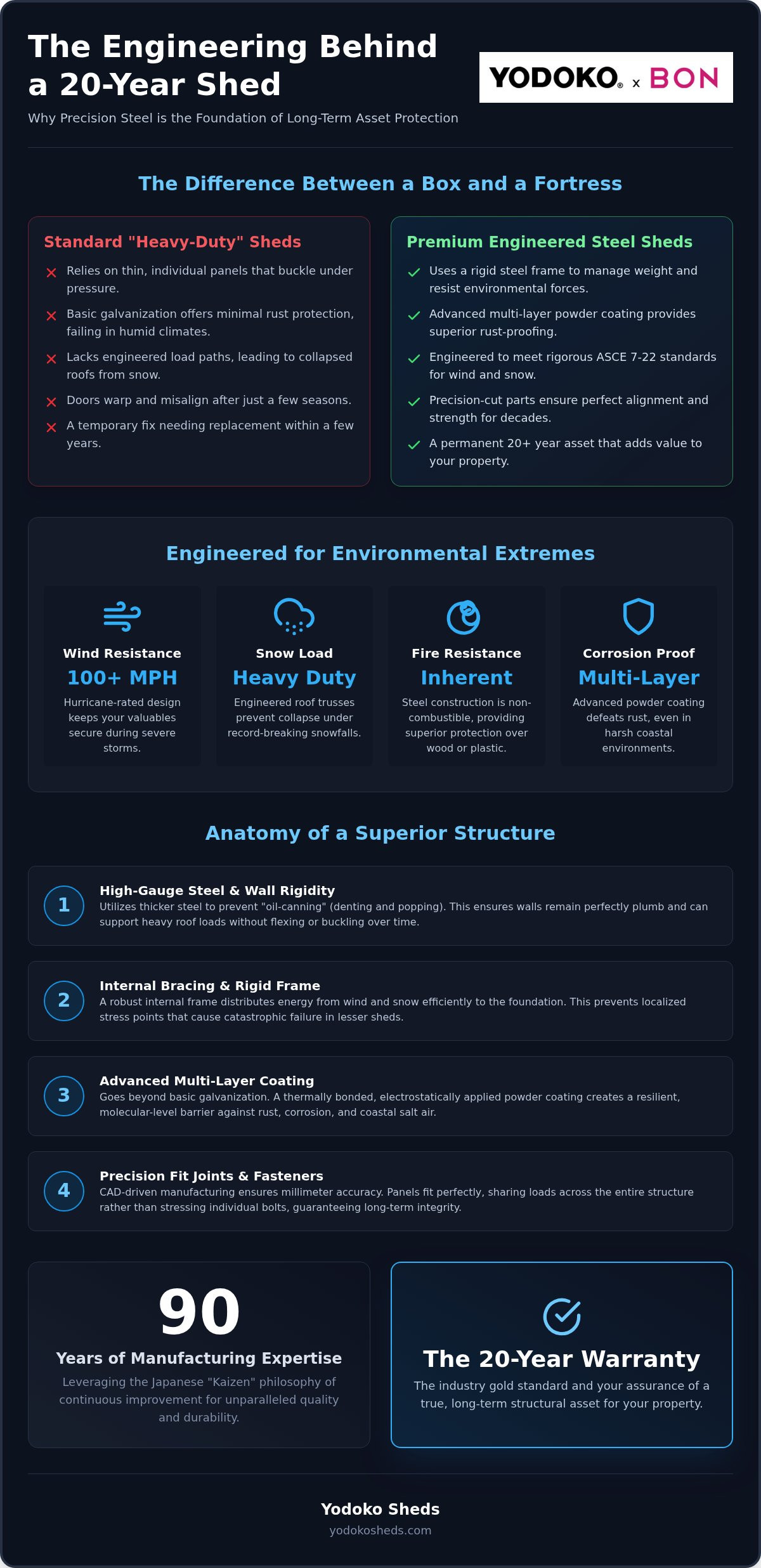
True steel shed engineering is the precise synergy between advanced material science and structural design. It's what separates a flimsy metal container from a permanent property asset. While many homeowners view a shed as a simple box for lawnmowers, professional engineering ensures that every component works together to resist environmental forces. This discipline involves calculating stress points, wind resistance, and weight distribution to create a structure that remains stable for decades.
Many "off-the-shelf" budget sheds fail because they lack engineered load paths. When heavy snow sits on a roof or high winds push against a wall, the energy needs a clear route to the foundation. Without this, the structure experiences localized stress, leading to buckled panels or collapsed roofs. Transitioning to a high-quality storage solution means moving away from temporary garden fixes toward a long-term investment. When you evaluate the total cost of ownership, a well-engineered shed like the YODOKO LMDS provides superior value by eliminating the need for replacements every few years.
The Difference Between a Metal Box and an Engineered Structure
A standard metal box relies on the strength of individual panels, but an engineered structure uses a rigid frame to manage weight. This ensures that structural load moves efficiently from the roof through the vertical supports and into the ground. Precision is vital here. Components must meet strict structural steel specifications to prevent structural "creep," where minor misalignments worsen over time due to temperature changes and settling. By using precision-cut parts, premium sheds maintain their integrity and keep doors perfectly aligned; unlike cheaper models that become difficult to open after just one season.
The Evolution of Modern Steel Shed Design
Modern steel shed engineering has evolved far beyond the corrugated iron sheds of the past. Today, we use high-tensile, multi-coated steel alloys that provide exceptional resistance to rust and fire. The integration of Computer-Aided Design (CAD) allows manufacturers to achieve tolerances measured in millimeters, ensuring every bolt hole aligns perfectly for maximum joint strength. This technological shift has made it possible to offer hurricane-rated domestic storage that can withstand 100+ mph winds. As building codes like the 2024 IBC and ASCE 7-22 become more stringent, these engineering advancements ensure your storage asset remains compliant and secure regardless of the weather.
Key Components of Reinforced Shed Wall Construction
A shed's durability starts with its wall rigidity, which is a direct result of the steel's gauge. Advanced steel shed engineering prioritizes material thickness to ensure the structure doesn't just stand, but remains perfectly plumb under pressure. Thinner panels often lead to "oil-canning," that frustrating popping sound you hear when the metal expands or contracts. By using higher gauge steel and precision-calibrated "steps" in material thickness, manufacturers can eliminate these structural weaknesses. This rigidity prevents denting and ensures that the walls can support the roof load even during extreme environmental shifts.
Precision fit joints are equally vital for maintaining structural integrity. When panels fit together with millimeter accuracy, they share the load across the entire surface rather than stressing individual fasteners. This level of craftsmanship is a hallmark of Japanese manufacturing, where internal bracing and heavy-gauge paneling work in tandem. If you're looking for a structure that maintains its shape for decades, exploring the YODOKO LMDS Steel Shed range reveals how these engineering choices create a noticeably more stable building.
Material Science: Beyond Standard Galvanization
Most budget sheds rely on basic galvanization, which is just a thin layer of zinc. Premium engineering goes further by utilizing advanced multi-layer powder coating systems. This process starts at the molecular level, treating the steel with anti-corrosion primers before applying the final finish. Powder coating is a thermal bonding process where dry powder is applied electrostatically and cured under heat to create a resilient, protective layer. This technology ensures the shed remains rust-proof even in humid or coastal environments where standard metal buildings would quickly fail.
Reinforced Joints and Fastening Systems
The lifespan of a shed is often determined by its smallest components: the screws and bolts. Standard fasteners can become the primary site for localized corrosion, eventually weakening the entire frame. Engineered systems use weather-sealed fasteners with integrated washers to keep moisture out of the puncture points. Interlocking panel designs further enhance security by reducing the number of exposed screws. This design choice doesn't just look cleaner; it creates a more secure, fire-proof envelope that is much harder for intruders to compromise. By minimizing puncture points, the structural integrity of the steel remains intact for the full 20-year warranty period.
Engineering for Extremes: Wind, Snow, and Fire Resistance
Designing for environmental extremes requires more than just thick metal panels; it demands a comprehensive understanding of force distribution. High-performance steel shed engineering focuses on how a structure behaves under the violent pressures of nature. Whether it's the sheer force of a gale or the heavy, silent weight of a blizzard, every component must work in unison to maintain structural shape. This level of planning ensures your storage isn't just a container, but a shield for your property.
Uplift is the primary cause of structural failure during severe storms. As wind moves rapidly over a roof, it creates a low-pressure zone that tries to pull the building upward. Robust anchoring systems are essential to counteract this, but the frame itself must be strong enough to transfer that upward force from the roof down through the walls. Fire safety is another critical pillar of modern design. Unlike wood or resin alternatives, steel is inherently non-combustible. In wildfire-prone zones, an engineered steel structure provides a vital fire-resistant envelope that won't contribute fuel to a passing blaze.
High-Velocity Hurricane Zone (HVHZ) Standards
To be truly hurricane-rated in 2026, a shed must be designed to survive winds exceeding 100 mph. This requires more than just strong walls; it necessitates reinforced door tracks and heavy-duty locking mechanisms. During a storm, the door is often the most vulnerable point. If it fails, internal pressure builds rapidly, often leading to a total roof blowout. Precision engineering ensures that doors remain seated in their tracks even under extreme pressure. For a deeper look at these specifications, you can consult our guide on Premium Metal Sheds: The 2026 Buyer’s Guide to see how different models handle high-velocity zones.
Structural Integrity Under Heavy Snow Loads
Heavy winter climates require a different set of engineering priorities, specifically focusing on pounds per square foot (PSF) capacity. The 2024 IBC and ASCE 7-22 standards have updated how we calculate these reliability-based snow loads. Roof sag is a common failure in non-engineered metal buildings where the rafters aren't spaced or sized correctly for the region's climate. The YODOKO LMDS and ESF models utilize specific roof geometries and high rafter density to encourage load shedding and prevent accumulation. By calculating the exact pitch and support needed, these sheds avoid the structural "creep" that leads to long-term damage in lesser structures. This precision ensures your shed remains standing even after the heaviest seasonal snowfall.
Evaluating Structural Integrity: A Buyer’s Checklist
Identifying high-quality steel shed engineering requires looking beyond the exterior paint. Most sheds look identical in a showroom, but their performance during a storm or over a decade of humidity tells a different story. To ensure you're buying a permanent asset rather than a temporary fix, you must audit the structural choices made during manufacturing. It's about verifying that the building was designed to handle the specific environmental stressors of your region.
Start by asking about the "engineering steps." This refers to how the manufacturer adjusts material thickness as the shed size increases. A larger shed requires thicker steel to maintain the same structural integrity as a smaller model. If a brand uses the same thin gauge for a 6-foot shed and a 12-foot shed, the larger unit is fundamentally compromised. Next, inspect the door mechanism. A door that glides effortlessly on its track is the best indicator of a perfectly square, engineered frame. If the frame is even slightly out of alignment, the doors will stick or drag, which is a sign of poor structural control.
The Warranty as an Engineering Proof Point
A 20-year structural warranty is the gold standard for a reason. It isn't just a marketing claim; it's a statement of engineering confidence. It's vital to distinguish between a "finish warranty," which covers paint peeling, and a "structural warranty," which covers the integrity of the frame and panels. A 20-year guarantee often implies an expected functional lifespan of 40 years or more. Be wary of "limited" warranties that exclude damage from salt-air or high humidity, as these are often the very conditions that test a shed's limits. High-quality steel shed engineering accounts for these factors by using advanced multi-layer coatings.
Fit, Finish, and Tolerances
Precision is visible in the smallest details. You can perform a "paper test" by trying to slide a piece of paper through the panel joins. In a well-engineered structure, the tolerances are so tight that there are no gaps for light, water, or pests to enter. Pre-drilled holes are another sign of factory-controlled precision. They ensure that every fastener is placed exactly where the engineers intended, preventing the structural "creep" that occurs when installers have to force components together. For a deeper look at these technical requirements, read our Steel Sheds: The Complete Buyer’s Guide for 2026.
If you're ready to invest in a structure that meets these rigorous standards, explore the Yodoko Sheds inventory to find a model that fits your property.
The Japanese Precision Advantage in Steel Shed Engineering
The 90-year legacy of Japanese steel manufacturing is built on a foundation of relentless precision. In Japan, steel shed engineering is driven by the "Kaizen" philosophy, which demands continuous improvement in every bolt, track, and panel. This isn't just marketing; it's a structural necessity born from a geography prone to extreme earthquakes and typhoons. When a manufacturer designs for those conditions, the result is a product that is significantly over-speced for the average backyard. This creates a level of reliability that budget brands simply cannot match, as every YODOKO structure is built to withstand forces far beyond standard residential requirements.
The YODOKO LMDS and ESF models represent the pinnacle of this design evolution. By focusing on the synergy between high-tensile materials and robotic fabrication, these sheds offer a level of consistency that manual manufacturing processes lack. This heritage of excellence ensures that when you choose a Japanese-engineered solution, you aren't just buying a storage box; you're investing in decades of metallurgical research and structural testing.
The Yodoko Manufacturing Philosophy
The Yodoko approach to manufacturing prioritizes rust-proof longevity through advanced metallurgical techniques. This involves more than just a surface treatment; it's about how the steel is forged and coated at the factory level. By utilizing Japanese robotics in component fabrication, every piece is cut to a fraction of a millimeter. This precision is why "Made in Japan" engineering translates to a much easier assembly process for you. Because every hole aligns and every panel interlocks perfectly, the final structure is inherently stronger and more stable than those that require forced fitting during installation.
Why Engineering Excellence is a Financial Investment
Choosing a premium shed is a strategic financial decision that impacts your property's long-term value. A high-end, engineered shed acts as a permanent outbuilding rather than a temporary fixture. Because these structures are designed to be maintenance-free, you save significantly over time. You won't spend weekends painting rusted corners or repairing warped frames. When you consider the cost of NOT having to replace your shed for 20 years or more, the value of superior steel shed engineering becomes clear. It provides the peace of mind that your valuables are protected by a structure that is fire-proof, hurricane-rated, and built to last a lifetime.
Ready to upgrade your property with world-class durability? Explore our Japanese-engineered LMDS and ESF collections to find the perfect storage asset for your home.
Invest in a Lifetime of Structural Security
Choosing a storage solution in 2026 requires looking beyond the initial price tag to the rigorous science of steel shed engineering. We've explored how material thickness, precision-cut joints, and advanced metallurgical coatings transform a simple metal building into a hurricane-rated property asset. A shed shouldn't just be a place to store your gear. It should be a maintenance-free structure that stands firm against high winds, heavy snow, and the constant threat of fire. True quality is found in the details that ensure your doors glide smoothly for decades.
By prioritizing Japanese precision and a 20-year structural warranty, you ensure that your investment adds real value to your home. You don't have to settle for flimsy panels or sticking doors when you can have a rust-proof and fire-proof solution built on 90 years of manufacturing history. It's time to choose a storage asset that offers total peace of mind regardless of the weather. View Our Hurricane-Rated Japanese Steel Sheds to secure your property today. Your valuables deserve the protection of world-class engineering that lasts a lifetime.
Frequently Asked Questions
What is the difference between galvanized and powder-coated steel?
Galvanized steel features a thin layer of zinc to prevent rust, but powder coating is a superior thermal bonding process. In premium steel shed engineering, powder coating provides a thicker, more resilient barrier that resists scratching and chemical exposure. While galvanization is a good start, the multi-layer powder coating found on YODOKO models ensures the structure remains aesthetically pleasing and rust-free for much longer.
How much wind can a hurricane-rated steel shed actually withstand?
A truly hurricane-rated shed is engineered to withstand winds exceeding 100 mph. This rating depends on the specific model and the quality of the anchoring system used during installation. By meeting 2026 standards like ASCE 7-22, these structures manage the physics of uplift and lateral pressure. Proper door reinforcement and internal bracing ensure the shed remains a secure envelope even during severe coastal storms.
Does a steel shed need a concrete foundation for structural integrity?
A level concrete foundation is highly recommended to ensure the long-term structural integrity of your shed. While some smaller models can sit on paved surfaces, a dedicated slab provides the most secure anchoring point for hurricane-rated performance. A solid base prevents the frame from settling unevenly, which is the most common cause of door misalignment and joint stress over a 20-year lifespan.
Are steel sheds fire-proof enough for high-risk wildfire areas?
Steel is inherently non-combustible, making it an excellent choice for high-risk wildfire zones. Unlike wood or resin alternatives, a steel shed won't ignite from flying embers or contribute fuel to a fire. While no structure is entirely fire-proof in extreme conditions, the fire-resistant materials and tight tolerances of Japanese-engineered sheds provide a critical protective barrier for your stored equipment and valuables.
How do I prevent condensation in a modern steel shed?
Preventing condensation starts with proper air circulation and a moisture barrier under your foundation. Modern steel shed engineering includes integrated vents that allow for consistent airflow without compromising security or weatherproofing. Keeping the shed slightly off the ground and ensuring the interior isn't overcrowded will help maintain a dry environment. This protects your tools from the humidity that often leads to surface oxidation.
What does a 20-year structural warranty actually cover?
A 20-year structural warranty typically covers the integrity of the frame and panels against rust-through and manufacturing defects. It's a guarantee that the building will remain standing and functional under normal environmental conditions. This coverage is much broader than a standard finish warranty, which only applies to paint peeling. It reflects the manufacturer's confidence in the metallurgical quality and structural design of the storage unit.
Can I assemble a Japanese-engineered steel shed myself?
Yes, the precision of Japanese manufacturing makes these sheds remarkably straightforward for DIY assembly. Because every component is robotic-cut and every bolt hole is pre-drilled with millimeter accuracy, you won't need to force parts together. Most homeowners can complete the installation with basic tools in a single weekend. However, we also offer a professional Assembly Service if you prefer a turnkey solution for your property.
Do these sheds require any annual maintenance to prevent rust?
These sheds are designed to be virtually maintenance-free, requiring only occasional cleaning with mild soap and water. You won't need to paint, sand, or apply specialized rust inhibitors thanks to the advanced multi-layer coatings. Simply keeping the door tracks clear of debris and ensuring the vents are unobstructed is enough to preserve the structure. This ease of care is a primary benefit of choosing a high-end engineered storage asset.