

Shed Wind Rating Standards: Debunking Myths About Structural Integrity
A "windproof" label on a backyard shed is often more about clever marketing than genuine structural engineering. When a storm hits, the last thing you want is a storage unit that transforms into a dangerous projectile. It's completely normal to feel skeptical of prefabricated metal structures, especially when you're caught between confusing wind zones and conflicting mph claims. You want a shed that protects your investment, not one that buckles under the first sign of pressure.
We understand the frustration of trying to decode complex shed wind rating standards across different regions. Whether you're navigating requirements for 135 mph winds or intense 180 mph codes in demanding areas, the data can feel overwhelming. This article promises to strip away the jargon and provide the truth about wind load capacities and structural integrity. You'll learn how to identify a high-quality structure that actually survives high-velocity winds. We will look at the latest ASCE 7-22 standards, explore why precision Japanese engineering sets a higher bar for durability, and show you how to find a shed built to stand for decades.
Key Takeaways
- Understand that wind ratings are technical measurements of pressure resistance, not just marketing terms used to sell "sturdy" structures.
- Learn how to navigate complex shed wind rating standards by matching your local wind zone requirements with official ASCE 7-22 guidelines.
- Discover why even the best anchoring kits won't save a shed if the roof and walls aren't engineered to handle high-velocity wind loads.
- Get a clear, two-step process for verifying manufacturer certifications and building code compliance before making a purchase.
- Explore how 90 years of Japanese engineering and premium steel construction create a structural "over-engineered" safety net for your property.
What Are Shed Wind Rating Standards and Why Do They Matter?
Shed wind rating standards aren't just technical jargon found in a manual; they represent the structural limit of your property's safety. A wind rating measures the maximum wind speed or pressure a structure can endure before catastrophic failure occurs. For most homeowners, this is the difference between a secure storage space and a pile of debris in a neighbor's yard after a storm. Understanding these standards is essential for anyone living in regions prone to high-velocity winds.
A common "flimsy" myth persists because many people associate metal sheds with the thin, rattling structures found at big-box retailers. These non-rated models have given metal a reputation for being unstable. However, premium steel sheds are engineered to a completely different standard. High-quality construction ensures the unit stays anchored and intact, protecting your valuable equipment and maintaining insurance compliance. Without a certified rating, you're essentially gambling with your property during every storm season.
Adhering to these standards involves looking at The Science of Standards: ASCE 7 and Wind Zones, which dictates how structures must respond to environmental forces. These benchmarks are the foundation of modern building codes, ensuring that "hurricane-rated" structures can withstand the intense pressures of a major weather event.
The Difference Between Wind Speed and Wind Load
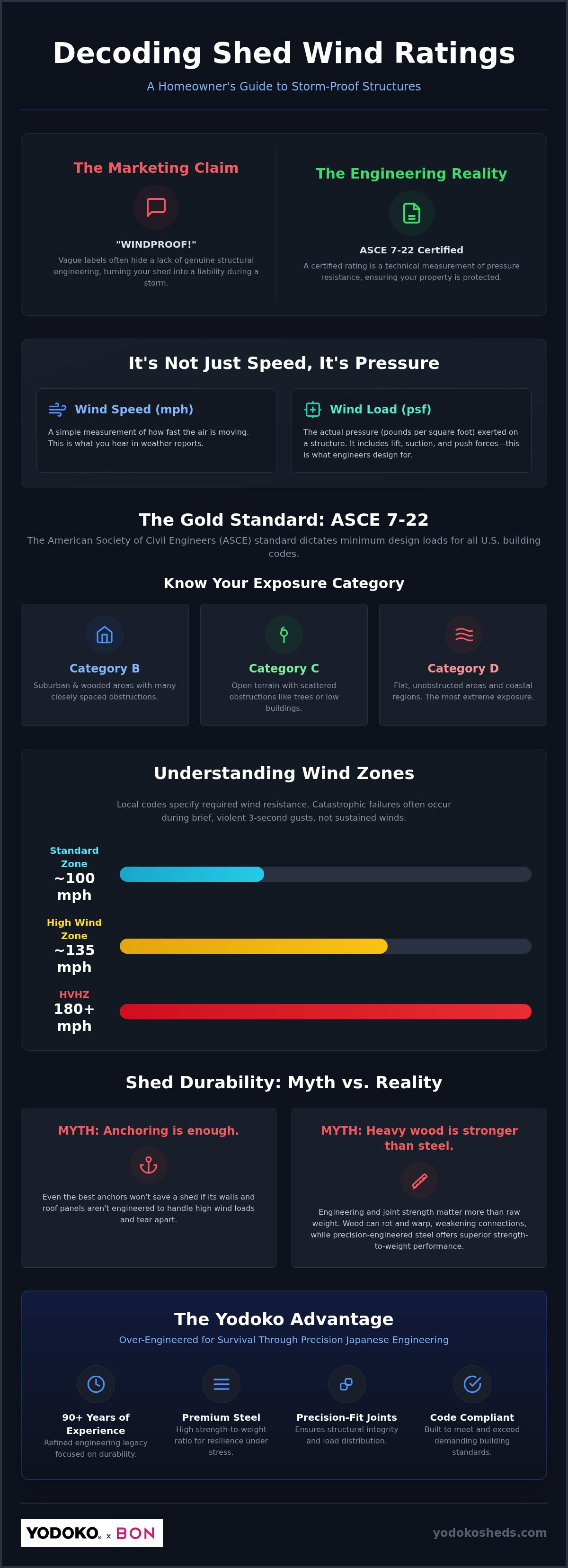
A 100 mph wind doesn't just push against a flat wall. It creates complex aerodynamic forces, including lift on the roof and suction on the leeward side. While wind speed is a simple measurement of air movement, wind load is a more accurate engineering metric because it calculates the actual pressure exerted on the structure. Wind load is the total force applied to a surface by moving air. Engineering for wind load ensures the shed can resist being lifted off its foundation or having its roof panels peeled away by negative pressure.
Common Myths About Shed Durability
There's a persistent belief that a heavy wood shed is naturally superior to a steel one during a storm. In reality, raw weight is far less important than engineering and joint strength. Wood can rot, swell, or warp over time, weakening the very connections that hold the structure together. Precision Japanese steel engineering, refined over 90 years by Yodoko, focuses on high strength-to-weight ratios. This allows for a structure that's more resilient under high-stress environments than traditional timber. By using superior materials and precision-fit joints, these steel sheds provide a level of security that bulky, non-engineered alternatives simply can't match.
The Science of Standards: ASCE 7 and Wind Zones
Engineering a structure to survive a storm requires more than guesswork. It demands a rigorous adherence to the American Society of Civil Engineers (ASCE) standards, specifically ASCE 7. This document serves as the gold standard for U.S. building codes, providing the data necessary to calculate minimum design loads for buildings. When we discuss shed wind rating standards, we're referring to a framework that has become significantly more sophisticated with the release of ASCE 7-22. This latest version incorporates high-resolution hazard maps and, for the first time, specific provisions for tornado resilience, reflecting a 2026-era commitment to total structural safety.
Your shed's performance is also dictated by its environment, classified into "Exposure Categories." Category B applies to suburban areas with many obstructions. Category C covers open terrain with scattered trees. Category D is the most extreme, representing flat, unobstructed areas near large bodies of water. A shed that stands perfectly in a wooded backyard might fail in a coastal field because the wind hasn't been slowed by friction. Understanding these categories is the first step in ensuring your storage solution won't fail when the pressure rises.
Understanding Wind Speed Maps
Identifying your risk starts with local wind speed maps. If you live in a High Velocity Hurricane Zone (HVHZ), such as Miami-Dade or Broward County, your requirements are the strictest in the nation. In these areas, sheds must often withstand 3-second gusts of up to 186 mph. It's vital to distinguish between sustained wind speeds, which are 1-minute averages, and 3-second gusts. Most catastrophic failures occur during those brief, violent peaks of energy. Even inland residents shouldn't ignore these ratings; localized microbursts can produce winds exceeding 100 mph, easily flattening an unrated structure.
Testing Protocols for Hurricane-Rated Sheds
A truly hurricane-rated shed undergoes two primary types of evaluation: static pressure testing and impact testing. Static pressure testing simulates the relentless push and pull of high-velocity air, ensuring the panels don't buckle or detach. Impact testing is even more dramatic, involving the launching of debris at the structure to simulate flying limbs or shingles. Yodoko’s Japanese-engineered panels are designed to maintain structural integrity under these extreme conditions, utilizing premium steel that offers a superior strength-to-weight ratio. You can learn more about steel shed engineering to see how these materials are refined for maximum resilience. If you're ready to invest in a structure that meets these rigorous benchmarks, consider the hurricane-rated Yodoko steel shed lineup for your property.
Myth vs. Reality: Does Anchoring Make Any Shed Safe?
Many homeowners believe a cheap anchoring kit can transform a bargain-bin storage unit into a storm-resistant fortress. This is a dangerous misconception. While anchors are a critical part of the equation, they can't compensate for poor engineering or low-grade materials. If the structure itself isn't built to meet modern shed wind rating standards, the anchors may hold the floor in place while the rest of the shed disintegrates around it. You're left with a bolted-down base and a backyard full of debris.
The "weakest link" theory is the most important concept in wind engineering. A shed is a complex system of interconnected parts. If the roof panels aren't securely fastened to the rafters, or if the walls lack the rigidity to resist buckling, the most expensive anchors in the world won't prevent a disaster. High-velocity winds create massive uplift forces that try to peel the roof away. A well-engineered structure, like the YODOKO LMDS Steel Shed, is designed to transfer that energy from the roof, through the frame, and safely down into the foundation. This synergy between material quality and the anchoring system is what separates a premium product from a temporary fix.
The Limits of Post-Market Anchoring Kits
Anchors are only as effective as the points where they attach to the shed's frame. Most post-market kits rely on thin-gauge steel or plastic components that can easily tear away when subjected to pressure. In these cases, the anchor stays in the ground, but the shed's wall or base frame rips apart at the connection point. Professional-grade solutions utilize integrated anchoring points designed during the manufacturing process. By building these attachment points directly into a heavy-duty steel frame, the structure maintains its integrity even when the wind load reaches its peak. It's a matter of precision engineering versus an afterthought.
Foundation Requirements for High-Wind Zones
Choosing the right foundation is just as vital as the shed itself. While gravel pads are popular for drainage, they offer very little resistance to overturning forces. A concrete slab provides the necessary dead weight and a solid medium for mechanical anchors. When you bolt a YODOKO ESF Steel Shed directly into a reinforced concrete pad, you're creating a unified mass that's much harder for wind to move. Our Assembly Service ensures that every anchor is set to exact engineering specifications, removing the guesswork from the installation. This level of precision is non-negotiable for anyone living in high-wind regions who values long-term property protection.
How to Evaluate a Shed's Wind Performance Before Buying
Buying a shed based on looks alone is a mistake that often leads to property damage. To ensure your investment survives a hurricane, you need a systematic approach to evaluation. Start by contacting your local building department to confirm the specific wind speed requirements for your area. For instance, if you're in coastal South Carolina, you likely need a structure rated for at least 135 mph. In parts of Florida, that requirement can jump to 180 mph. Once you have this number, you can accurately compare shed wind rating standards across different brands.
Next, demand to see the manufacturer's official wind load certification documents. Reputable companies provide engineering proof rather than vague promises. You should also inspect the material quality. Most big-box sheds use standard carbon steel that's often too thin to resist buckling. In contrast, Japanese steel is renowned for its superior strength-to-weight ratio, allowing it to withstand extreme stress without adding unnecessary bulk. Finally, look for a 20-year structural warranty. A long-term guarantee is the ultimate sign that a manufacturer trusts their engineering to hold up against the elements year after year.
Red Flags in 'Hurricane-Proof' Claims
Be wary of products described with vague marketing terms like "storm-resistant" or "heavy-duty" that lack a specific mph rating. If a salesperson can't provide a technical data sheet, the structure probably hasn't been tested. Another major red flag is thin steel. Any paneling thinner than 29-gauge is generally insufficient for high-wind zones, as it can easily tear at the fastener points. Protecting your structure also means looking at finishes; you can discover the powder coated steel shed benefits that prevent rust from eating away at your shed's structural integrity over time.
Reinforcement Features to Look For
A truly resilient shed incorporates specific design elements that prevent structural failure during a storm. Look for these critical features:
- Overlapping wall panels: These prevent wind from catching an edge and peeling the panel away from the frame.
- Reinforced corner bracing: This keeps the structure "square" and prevents the racking that leads to collapse.
- Heavy-duty door tracks: Doors are often the first point of failure; ensure they are reinforced to stay on their tracks during high-pressure events.
- Double-walled construction: This adds a layer of impact resistance against flying debris.
Evaluating these details ensures you're buying a professional-grade solution rather than a temporary fix. If you're ready to secure your property with a structure that sets the industry benchmark, explore our hurricane-rated steel sheds today.
Yodoko's Japanese Engineering: Built for Extreme Survival
Yodoko's approach to structural integrity isn't a recent development. With over 90 years of engineering history, the brand was forged in one of the most storm-prone regions on the planet. Japan's unique geography requires buildings to withstand both intense typhoons and significant seismic activity. This heritage is the foundation of our shed wind rating standards. We don't just build for "average" weather; we engineer for the extremes that occur once in a generation. When you choose a Yodoko structure, you're benefiting from nearly a century of refinement in material science and aerodynamic design.
Japanese steel is the international benchmark for a reason. It offers an unmatched strength-to-weight ratio, which is vital for high-performance outbuildings. The YODOKO LMDS Steel Shed and YODOKO ESF Steel Shed utilize this premium material to remain rigid under pressure without the bulk of traditional construction. We stand behind this engineering with a 20-year structural warranty. This isn't just a marketing claim; it's a professional guarantee that your shed will maintain its form and function long after standard models have failed.
Precision Manufacturing vs. Standard Prefab
Standard prefabricated sheds often rely on manual assembly methods that allow for small errors in alignment. At Yodoko, we use computer-aided design (CAD) to ensure every joint, panel, and fastener contributes to the structure's overall wind resistance. This precision ensures that the wind load is distributed evenly across the frame. A major factor that many competitors ignore is the role of rust. Corrosion eats away at steel, creating microscopic weak points where wind can eventually cause a total collapse. Yodoko sheds are fireproof and rust-proof, making them a permanent asset. By preventing rust, we ensure the structural integrity remains at 100% for decades.
Investing in Peace of Mind
When you calculate the total cost of ownership, a hurricane-rated shed is the most economical choice for any property owner. Replacing a "bargain" shed every few years after a storm is expensive, frustrating, and potentially dangerous for your surroundings. Your valuables deserve better than a flimsy enclosure. Whether you're storing motorcycles, high-end tools, or critical business inventory, they require a space that has been engineered to survive. By choosing a structure that meets the highest 2026 benchmarks, you're buying long-term security. Explore Yodoko's Hurricane-Rated Steel Sheds to find a solution that offers true peace of mind during storm season.
Choose a Structure Built for the Long Term
Selecting a storage solution shouldn't be a gamble with the next storm season. We've explored how true structural integrity comes from precision engineering rather than just raw weight or aftermarket anchoring kits. By understanding the latest shed wind rating standards and the science behind ASCE 7-22, you're now equipped to look past marketing fluff and identify a structure that genuinely protects your assets.
Yodoko brings 90 years of Japanese engineering expertise to your backyard. Our sheds aren't just built to survive; they're designed as permanent, rust-proof, and fire-proof assets for your property. With a 20-year structural warranty, we provide the peace of mind that comes from knowing your equipment is sheltered by the global standard in steel construction.
Don't wait for the next high-velocity wind event to test your storage. Invest in a solution that was born in one of the most weather-challenged regions on earth. Secure your property with a Yodoko Hurricane-Rated Steel Shed today. You've done the research; now it's time to choose the reliability your home deserves.
Frequently Asked Questions
What is the minimum wind rating for a shed in a coastal area?
Minimum wind ratings for coastal regions typically range from 135 mph to 180 mph depending on your specific state and county. In Florida's hurricane-prone zones, requirements often start at 150 mph; however, in High Velocity Hurricane Zones like Miami-Dade, the standard can reach 186 mph. These shed wind rating standards ensure the structure can handle the intense pressure of coastal gusts. Always verify the local building code before purchasing a storage unit.
Can I make my existing shed hurricane-proof with a kit?
No, you cannot truly hurricane-proof a non-rated shed using a simple anchoring kit. While anchors prevent the base from moving, they do nothing to reinforce the walls or roof against uplift and lateral pressure. If the frame is flimsy, the wind will simply tear the structure apart while the floor stays bolted down. True storm survival requires a system-based engineering approach where every component is designed to work together.
Do I need a building permit for a wind-rated shed?
Yes, most local municipalities require a building permit for any permanent outbuilding, especially those meeting specific shed wind rating standards. The permit process ensures your shed is anchored correctly and complies with regional safety codes. In many coastal areas, you must submit engineering documents from the manufacturer to prove the structure can withstand local wind speeds. Skipping this step can lead to fines or complications with property insurance.
What is the difference between a wind rating and a snow load rating?
A wind rating measures the structure's ability to resist lateral pressure and uplift forces from moving air. Conversely, a snow load rating measures the vertical weight a roof can support before collapsing. Yodoko sheds are engineered to handle both, with a floor load capacity of 337 lb/sqft and snow loads up to 62 PSF. While both are important for structural integrity, they address entirely different environmental stresses.
How do I find the wind zone for my specific address?
The most accurate way to find your wind zone is to use the ASCE 7 Hazard Tool or contact your local building department. These resources provide digital data based on your exact coordinates and historical storm patterns. You'll receive a specific mph requirement that matches the current ASCE 7-22 standards. Knowing this number is the only way to ensure you buy a shed that is legally compliant and physically safe.
Are steel sheds better than wood sheds for high winds?
Steel sheds are generally superior for high-wind environments because they offer a higher strength-to-weight ratio and more precise connections. Unlike wood, which can rot or warp at the joints over time, Japanese-engineered steel maintains its structural rigidity for decades. Precision-fit panels and reinforced tracks prevent the wind from "catching" edges. When combined with rust-proof coatings, steel remains a reliable, permanent asset that won't weaken as it ages.
Does a 20-year warranty cover wind damage?
A 20-year structural warranty typically covers defects in materials and workmanship that would cause the structure to fail under its rated conditions. It serves as proof of the manufacturer's confidence in their engineering. However, "acts of God" or damage from storms exceeding the rated wind speed are usually handled by your homeowner's insurance policy. Always check your policy to ensure your outbuildings have documented compliance certifications for storm damage coverage.
What happens if a shed isn't wind-rated and a storm hits?
If an unrated shed is caught in a major storm, it often becomes a dangerous projectile that can damage your home or neighbor's property. Beyond the total loss of your stored valuables, you may face significant liability for any damage the debris causes. Furthermore, many insurance companies will deny claims for outbuildings that don't meet local building codes. Investing in a certified, hurricane-rated structure is the only way to mitigate these risks.