

Storage for Business Inventory: A 2026 Case Study in On-Site Efficiency
What if you could transform your monthly storage rent into a permanent business asset that pays for itself in under twenty-four months? You're likely tired of the rising costs of commercial rental space and the time wasted driving to off-site facilities. It's a common frustration to worry about fire, theft, or weather damage while your high-value stock sits in a unit you don't even control.
This article will show you how to secure storage for business inventory by utilizing high-security, Japanese-engineered steel warehouses that live right on your property. We'll examine how the Yodoko LMDS serves as a private mini-warehouse, offering a rust-proof and fire-proof environment that lowers long-term overhead while providing immediate 24/7 access to your products. By shifting from a rental model to an ownership model, you'll see how a 20-year structural warranty acts as a powerful risk-mitigation tool for your company's future.
Key Takeaways
- Learn why switching to on-site storage for business inventory eliminates the hidden costs of fuel, labor, and unpredictable rental hikes.
- Discover how Japanese-engineered steel provides a fire-proof and rust-proof environment that outperforms standard commercial storage options.
- See how e-commerce businesses use the Yodoko LMDS series as a private mini-warehouse to manage high-volume stock with 24/7 access.
- Compare the long-term financial benefits of owning an industrial-grade asset against the cumulative cost of monthly storage fees.
- Get a step-by-step guide on selecting the right unit size and preparing a professional foundation for heavy inventory loads.
The Inventory Crisis: Why Off-Site Self-Storage Often Fails Growing Businesses
Many entrepreneurs start their journey in a garage or a spare room. As they scale, they often turn to off-site self-storage facilities as a quick fix. It seems convenient at first. However, relying on external units for storage for business inventory eventually creates a bottleneck that stifles growth and eats into profit margins. You're no longer just paying for space; you're paying for the constant inconvenience of being separated from your physical assets.
The Problem with Monthly Rental Fees
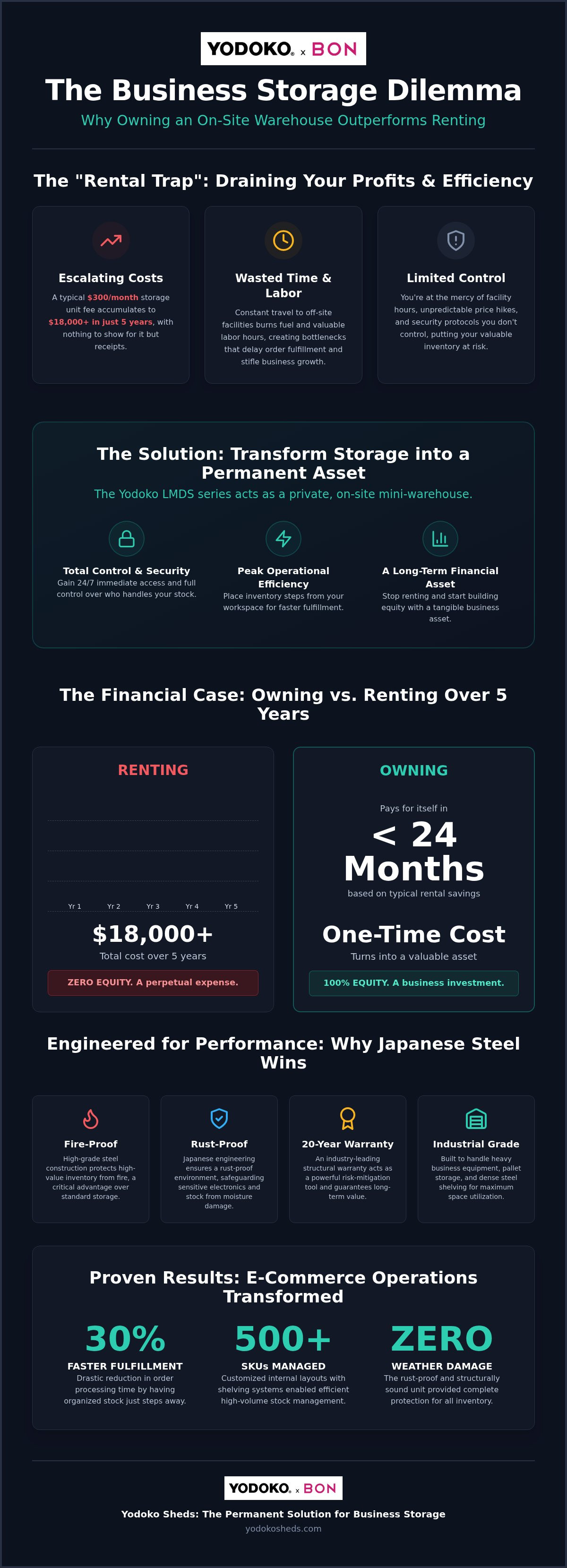
The "Rental Trap" is a silent profit killer that many small to medium businesses fail to calculate until it's too late. If you pay $300 every month for a medium-sized unit, you've spent $18,000 over five years. At the end of that period, you own nothing but a stack of receipts. Most commercial rental units offer basic protection, but they often lack the high-end pest control or structural integrity needed for high-value stock. You're also at the mercy of the facility owner. Price surges are common, and facility-wide access issues can bring your operations to a standstill without any warning.
Operational Friction in Inventory Management
Efficiency relies on proximity. When your team spends thirty minutes driving to a locker, loading a van, and driving back, you're losing more than just fuel. You're losing labor hours that could be spent on fulfillment or product development. Effective inventory management requires a space where items are organized, visible, and immediately accessible. For e-commerce brands, every minute saved in the warehouse translates to faster shipping times and better customer reviews. Moving your storage for business inventory on-site allows for a more granular organization of high-SKU stock that generic rental spaces simply can't support.
Shared facilities also present a unique security risk. You cannot control who has access to the hallways or the unit next to yours. A private, on-site steel warehouse gives you total control over who touches your stock. You don't have to wait for a facility gate to open at 9:00 AM to pull a "just-in-time" order for a priority client. You have 24/7 immediate access, allowing you to manage stock on your own terms. This shift in mindset transforms storage from a passive expense into an active, industrial-grade asset. By choosing a durable solution like a Yodoko LMDS, you're investing in a "private mini-warehouse" that protects your stock from fire, theft, and weather while keeping it exactly where you need it.
Case Study: Scaling E-Commerce Operations with On-Site Steel Storage
By 2026, successful e-commerce brands have moved beyond the "cramped garage" phase. One specific business reached a tipping point with 500 unique SKUs, where finding a single item took ten minutes of digging through disorganized boxes. They needed a dedicated space for storage for business inventory that didn't involve a daily commute to a rental facility. The solution was the Yodoko LMDS series, a Japanese-engineered steel unit that provides industrial-grade protection directly on their property.
Phase 1: Assessing Inventory Volume and Footprint
The first step involves calculating the actual footprint needed for daily operations. Pallet storage requires wide access points, while individual SKU bins need accessible vertical reach. The business evaluated their ground-load capacity to ensure the concrete foundation could handle heavy business equipment and dense steel shelving. They selected the LMDS line for its larger capacity and high-performance sliding doors, which are essential for frequent daily access. This decision allowed them to implement advanced inventory management techniques without the limitations of a standard residential storage space.
Phase 2: Customizing the Internal Layout
Density is key when working within a controlled footprint. By using shed shelving systems for metal sheds, the business effectively doubled their storage density. They created dedicated picking lanes to streamline the walk-to-pick process, reducing wasted movement. Since Yodoko sheds are fire-proof and rust-proof, the owners safely installed LED lighting and basic moisture-prevention tools for their sensitive electronics. This customization transformed a simple shed into a high-functioning fulfillment center.
The results were immediate and measurable. Fulfillment time dropped by 30% because stock was organized and only steps away from the packing station. More importantly, they experienced zero weather-related stock loss despite heavy seasonal rains, thanks to the hurricane-rated engineering. If you're ready to stop renting and start owning your space, exploring the YODOKO LMDS Steel Shed is the first step toward operational independence. This case study proves that the right storage for business inventory isn't just about square footage; it's about building a secure, efficient foundation for long-term growth.
Engineering for Assets: Why Japanese Steel Outperforms Standard Commercial Options
When protecting high-value stock, the material housing that stock is just as important as the items inside. Japanese-engineered steel is recognized as the global gold standard for durability because it's built to withstand extreme environmental stress. For companies investing in storage for business inventory, this isn't just about getting a shed; it's about acquiring an industrial-grade shell that won't degrade over time. Unlike thin-gauge metal bins or plastic containers found at big-box retailers, these structures leverage a 90-year history of manufacturing excellence to deliver a superior storage environment.
The "rust-proof" advantage is a game-changer for businesses located in humid or coastal environments. Salt air and constant moisture can compromise the structural integrity of standard metal buildings in just a few years, leading to leaks that destroy sensitive stock. Yodoko's Japanese steel is specifically treated to resist oxidation, ensuring that the interior remains dry and the exterior remains pristine. This level of protection is essential for maintaining the resale value of your stock and the long-term viability of your on-site warehouse.
The Science of Structural Integrity
Panel warping is a common failure point in lower-quality outdoor structures. When panels warp, they create gaps that invite pests and moisture inside. Advanced steel shed engineering uses precision-cut panels and reinforced framing to maintain a perfectly square structure for decades. This integrity is further protected by galvanized and powder-coated finishes that provide a multi-layer barrier against corrosion. Because these units are designed to last, the 20-year structural warranty serves as a critical risk-mitigation tool, ensuring your capital investment remains a functional asset rather than a recurring maintenance headache.
Fire and Weather Resistance Standards
Safety is non-negotiable when your livelihood is at stake. Standard commercial storage often fails to meet the rigorous fire-rating certifications required for modern business insurance. Yodoko sheds utilize fire-proof construction, which provides a significant layer of protection against external hazards. This is particularly vital for urban businesses or those located in high-risk zones where fire safety is a top priority.
Additionally, these units are hurricane-rated, meaning they're engineered to withstand high-velocity wind zones that would shred a typical residential shed. Impact resistance protects your stock from hail and external debris, keeping your storage for business inventory safe even during the most severe weather events. Meeting these standards doesn't just protect your physical goods; it provides peace of mind by demonstrating a commitment to professional-grade safety. You're not just buying a box; you're building a fortress for your business assets.
Calculating ROI: The Financial Case for Owning vs. Renting Business Storage
Many business owners view storage as a standard monthly utility bill, similar to electricity or internet. This perspective is a mistake. When you pay for off-site rental units, you're financing someone else's asset while receiving zero long-term value in return. Transitioning to on-site storage for business inventory allows you to move that expense from the "liability" column to the "asset" column on your balance sheet. This isn't just about saving money; it's about building equity in your operational infrastructure.
Total Cost of Ownership (TCO) Breakdown
The math is straightforward. If a commercial storage unit costs $300 per month, you'll spend $10,800 over three years. That figure doesn't account for annual lease escalations, which often range from 5% to 10%. By contrast, a one-time investment in a Yodoko steel warehouse eliminates these recurring fees forever. When you analyze the long-term cost of shed ownership, the break-even point typically arrives within the first twenty-four to thirty-six months. Unlike wood structures that require painting and roof repairs, Japanese steel requires virtually zero upkeep. Additionally, these units maintain high resale value. If your business outgrows the space or moves locations, you can sell the unit on the secondary market, recouping a significant portion of your initial capital.
Asset Protection and Insurance Benefits
Beyond the direct rental savings, on-site ownership provides indirect financial gains through risk mitigation. High-quality secure storage for expensive tools and inventory significantly lowers your liability. Because Yodoko sheds are fire-proof and hurricane-rated, many commercial insurance providers may look more favorably on your coverage applications. You're effectively reducing the likelihood of a total-loss claim due to external disasters.
There's also the "hidden" cost of pest damage to consider. Termites and rodents can decimate paper products, textiles, or electronic components in a matter of weeks. A sealed, rust-proof steel environment provides a far superior barrier compared to the thin walls of a shared rental facility. Protecting your storage for business inventory from these environmental threats prevents thousands of dollars in unsalvageable stock loss. If you're ready to stop the monthly rental drain and start investing in your company's future, you can view our full range of industrial steel sheds to find the right fit for your site.
Implementing Your Private Warehouse: Selection and Setup with Yodoko
Setting up a dedicated on-site warehouse is a significant operational milestone. To ensure your storage for business inventory remains efficient for years, you must start with a precise audit of your current stock volume. Measure your largest pallets and calculate the total cubic feet required for your inventory. This data determines whether you need the expansive YODOKO LMDS Steel Shed or the more compact YODOKO ESF Steel Shed. It's the difference between having just enough room and having a space that allows your business to scale.
Selecting the Right Model for Your Industry
Retailers managing light overstock might favor the ESF line's smaller footprint. However, if you're handling heavy machinery or bulk raw materials, the LMDS is the superior choice. Its heavy-duty floor and wide-opening sliding doors make it a true private mini-warehouse. You should also consider Shed Accessories like anchoring kits and extra shelving units to maximize SKU density. High-density shelving prevents stock from becoming a disorganized pile. Security is paramount. Choosing the right anchoring kit turns a simple shed into a high-security vault that stays put even in hurricane-force winds.
The Path to Professional Installation
A warehouse is only as strong as its base. For industrial weight loads, a level concrete pad is mandatory. This prevents the steel panels from shifting and ensures the sliding doors operate smoothly for decades. While some might consider a DIY approach, our professional Assembly Service is the best choice for business continuity. It allows your team to focus on sales while experts handle the technical setup. This professional touch is even more critical when you're setting up specialized units like a motorcycle storage shed steel structure for fleet vehicles or high-value equipment. It provides a turn-key solution that gets your warehouse operational in a single day.
Once the structure is complete, the final phase is internal organization. Use Yodoko-specific shelving to utilize vertical space effectively. Implement a clear inventory tagging system and install high-grade security locks. This structured approach ensures your on-site storage for business inventory isn't just a place to put things. It's a high-performance fulfillment hub that supports your 2026 growth goals. You've moved from renting a locker to owning an industrial asset.
Build a Foundation for Long-Term Growth
Transitioning from the "rental trap" to an ownership model transforms your storage from a monthly liability into a permanent business asset. By bringing your warehouse on-site, you eliminate the friction of off-site commutes while gaining total control over your stock. Japanese engineering excellence ensures that your inventory remains protected by fire-proof and hurricane-rated steel that outperforms standard commercial alternatives.
Choosing the right storage for business inventory is a strategic decision that impacts your bottom line for decades. You've seen how modern brands use these units to slash fulfillment times and boost profitability. It's time to stop paying for space you'll never own and invest in a structure backed by a 20-year structural warranty. This is more than a shed; it's a high-performance hub for your professional future.
Invest in Your Own Private Warehouse: Shop the Yodoko LMDS Series
Take the first step toward operational independence and build a workspace that works as hard as you do.
Frequently Asked Questions
Is a steel shed secure enough for high-value business inventory?
Yes, high-quality steel sheds are exceptionally secure for storage for business inventory. Yodoko units feature precision-engineered panels that leave no pry points for intruders. When combined with heavy-duty anchoring kits and industrial-grade locks, they provide a level of security comparable to a private mini-warehouse. This localized control means you don't have to worry about the shared access vulnerabilities common in public self-storage facilities.
Do I need a special permit to install a business storage shed on my property?
Permit requirements vary significantly based on your local building codes and the footprint of the structure. Generally, smaller units may not require a permit; however, larger industrial-grade warehouses often do. We recommend contacting your local planning department to verify specific regulations for your area before installation. Ensuring your storage for business inventory meets local standards protects your investment from future legal or zoning complications.
How much weight can the floor of a Yodoko steel shed actually hold?
Yodoko sheds are engineered to handle heavy industrial weight loads. The LMDS series features a reinforced floor design specifically intended for dense inventory and business equipment. While they are incredibly robust, it's vital to install the unit on a level concrete foundation to distribute the weight evenly. This setup ensures the structural integrity remains intact even when the unit is filled to maximum capacity with high-SKU stock.
Can I store temperature-sensitive inventory in a metal shed?
Standard metal sheds are not naturally climate-controlled; however, you can modify them for temperature-sensitive goods. Adding insulation and solar-powered ventilation can help regulate the internal environment. For inventory that requires strict temperature ranges, like certain electronics or pharmaceuticals, we suggest using specialized internal containers or climate-control tools. The rust-proof Japanese steel provides an excellent outer shell, but the internal environment should be tailored to your specific product needs.
Is it cheaper to rent a storage unit or buy a Yodoko shed for my business?
While renting has lower upfront costs, buying a Yodoko shed is significantly cheaper over a three-to-five-year period. Monthly rental fees for commercial units are "dead money" that builds no equity. Owning a Japanese-engineered steel shed is a one-time capital investment that eliminates recurring lease hikes. This shift from a rental model to an ownership model allows you to treat your storage structure as a depreciable business asset with high resale value.
What happens to my inventory if the shed is exposed to fire or high winds?
Your inventory is protected by some of the highest engineering standards in the industry. Yodoko sheds are fire-proof and hurricane-rated, meaning they're built to stay standing and keep contents dry during severe weather events. The fire-resistant properties provide a critical barrier that standard sheds lack. This high level of protection is backed by a 20-year structural warranty, giving you peace of mind that your business assets are safe from environmental disasters.
How long does it take to assemble a business-grade steel shed?
Assembly time depends on the unit's size, but most business-grade sheds can be completed in a single day. Using our professional Assembly Service ensures the structure is perfectly level and secure from the start. This turn-key approach minimizes operational downtime, allowing you to move your inventory into the new space almost immediately. A professional setup also guarantees that the sliding doors and locking mechanisms function flawlessly for long-term use.
Are Yodoko sheds resistant to termites and other pests that destroy stock?
Yes, Japanese steel sheds are naturally resistant to termites, rodents, and other pests. Wood structures are often vulnerable to infestations that can quickly decimate paper products, textiles, or food-based inventory. Steel provides a solid, impenetrable barrier that pests cannot chew through. By choosing a rust-proof steel environment, you're effectively eliminating the risk of pest-related stock loss, which is a common and expensive problem in older, shared rental facilities.